
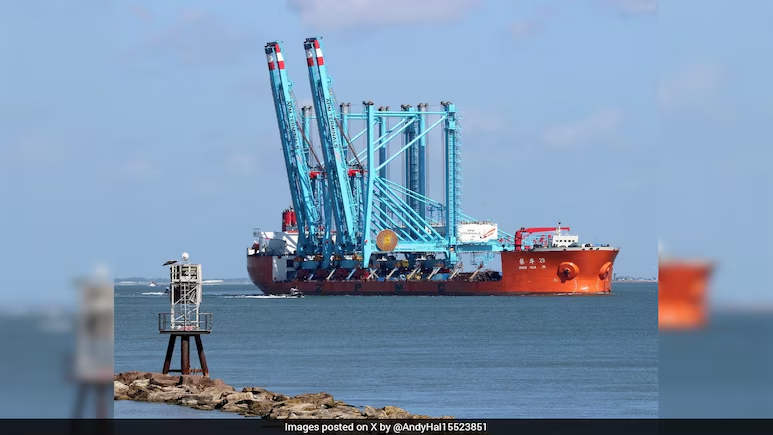
An 800-foot cargo vessel has drawn renewed attention to the vulnerabilities of global supply chains after completing an extraordinary six-month journey to deliver just five ship-to-shore cranes.
The heavy-lift vessel Zhen Hua 29 departed Shanghai on June 20, sailing west through the South China Sea and across the Indian Ocean before embarking on a circuitous route around the world. After travelling nearly 19,700 nautical miles and crossing three oceans, the ship finally docked at the Port of Kingston, Jamaica, in October. The cranes on board—manufactured in China—were destined for ports in Jamaica and along the US Gulf Coast.
According to The Washington Post, while such long-distance transport of heavy machinery has long been routine in global trade, the voyage of Zhen Hua 29 has raised concerns over ultra-long shipping routes and strategic dependencies.
In the United States, both Republican and Democratic administrations have increasingly voiced concerns about reliance on Chinese-made port equipment. US officials estimate that about 80 per cent of ship-to-shore cranes operating at American ports are manufactured in China, raising national security concerns. The White House has urged US ports to source cranes from alternative countries and revive domestic crane manufacturing, though industry experts note this will be difficult after nearly two decades of Chinese suppliers offering the most cost-effective and readily available options.
Under normal circumstances, the fastest route from Shanghai to Mississippi—via the Pacific Ocean and the Panama Canal—would take about a month. However, the cargo made that route impossible. The cranes’ massive booms extend beyond the ship’s sides, and Panama Canal authorities prohibit overhanging cargo that could damage canal locks and infrastructure. As a result, Zhen Hua 29 was forced to take the much longer route around Africa.
The most challenging leg of the journey was navigating the Cape of Good Hope at Africa’s southern tip, known for its severe sea conditions. Captain Ty McMichael said the vessel was delayed for nearly three weeks off the coasts of Mozambique and South Africa while waiting for 12-foot seas to subside.
The ship rounded Africa on August 14, crossed the Atlantic in about three weeks, and arrived in Gulfport, Mississippi, on September 11 after passing Venezuela’s northern coast. Following crane deliveries in Texas and Jamaica, Zhen Hua 29 was able to return home via the Panama Canal, completing its global circumnavigation and reaching Shanghai on December 3.
The voyage underscores both the logistical complexity of moving oversized industrial equipment and the broader geopolitical and security debates surrounding global maritime supply chains.