
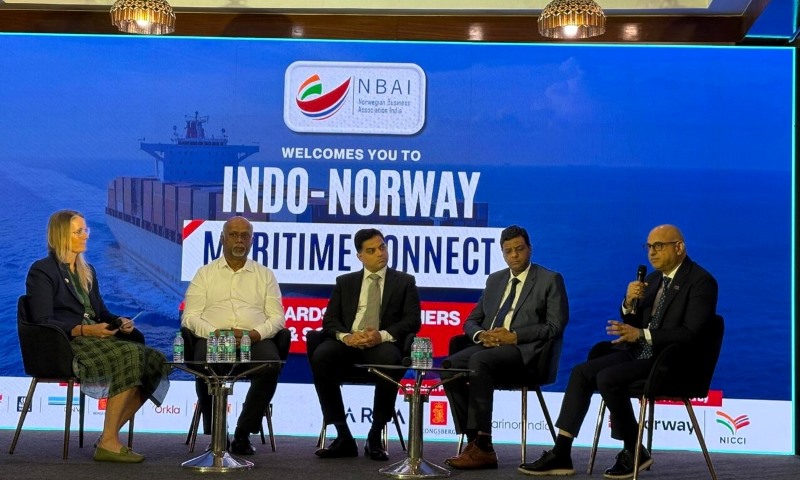
The National Bulk Handling Corporation India (NBAI) hosted a high-level conference on “Unlocking Opportunities in Harbor Tug Initiative under GTTP & Coastal Shipping” at MCA Club, BKC, bringing together key stakeholders from India’s maritime and shipping ecosystem.
The conference featured an engaging panel discussion with participation from leading industry players including JSW Steel Ltd., Polestar Maritime Ltd., and J.M. Baxi. The deliberations centered on emerging opportunities under the Green Tug Transition Programme (GTTP) and the rapid growth of coastal shipping in India.
Panelists highlighted that under the GTTP initiative, at least 150 harbour tugs with a bollard pull capacity of 60–70 tonnes are expected to be constructed at Indian shipyards over the next decade. These vessels are set to incorporate green technologies such as LFP/LTO battery systems, hybrid electric propulsion, and future-ready solutions including hydrogen fuel cells.
The discussion also underscored the accelerating momentum in coastal shipping, with major players like Adani Group, Transport Corporation of India, and Shipping Corporation of India actively expanding their fleets to support the sector’s growth.
Representatives from Varya, a company associated with over 30 European OEMs, expressed strong interest in establishing local manufacturing capabilities in India. The move aims to reduce capital expenditure for Indian shipyards and strengthen domestic supply chains. However, concerns were raised regarding limited access to affordable long-term financing for MSMEs, citing significantly higher interest rates in India (12–15%) compared to global peers such as China (3–4%).
While acknowledging initiatives like the Shipbuilding Financial Assistance Scheme (SBFAS) and the proposed Maritime Development Fund of approximately ₹70,000 crore as positive steps, industry participants pointed out that current benefits are largely skewed toward shipyard construction rather than equipment manufacturing. This imbalance, they noted, could hinder the competitiveness of Indian shipyards against Asian counterparts, particularly Chinese Tier 1 and Tier 2 yards.
Key recommendations emerging from the conference included extending financial assistance schemes to OEMs planning joint ventures or local production, rationalizing interest rates, and removing import duties on sub-components required for manufacturing ancillary equipment in India. Stakeholders emphasized that such reforms are critical to realizing the government’s Maritime Amrit Kaal Vision 2047 and positioning India as a global shipbuilding hub.
The conference concluded with a consensus on the need for collaborative policy support and industry alignment to unlock the full potential of green maritime technologies and coastal shipping in India.