
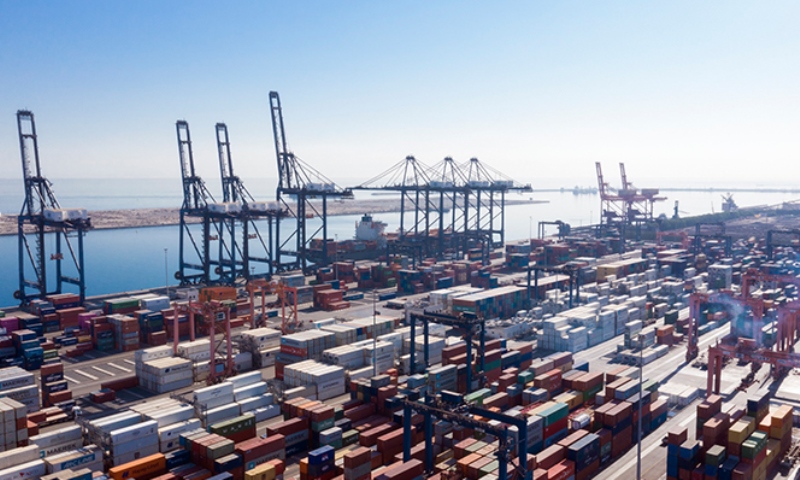
Ports in Oman located along the Indian Ocean are emerging as critical logistics hubs for Gulf nations and Indian food exporters as escalating tensions around the Strait of Hormuz continue to disrupt regional cargo vessel movements.
Industry officials said Omani ports, particularly Sohar Port, have played a key role in facilitating uninterrupted exports of food products from India to member nations of the Gulf Cooperation Council (GCC) in recent weeks.
The GCC bloc — comprising Saudi Arabia, United Arab Emirates, Oman, Qatar, Kuwait and Bahrain — depends heavily on food imports, sourcing nearly 85 per cent of its food requirements from overseas markets. India remains one of the region’s largest food suppliers.
Officials noted that Sohar Port, strategically located outside the Strait of Hormuz, has gained importance as an alternative gateway for regional trade amid growing geopolitical uncertainty in West Asia.
Opened in 2004, Sohar Port has evolved into one of the world’s fastest-growing deep-sea ports, spread across a 21-million square metre logistics and industrial complex. The hub currently hosts major logistics, petrochemicals and metals clusters, alongside a rapidly expanding food cluster.
The port is also home to Oman’s first dedicated terminal for handling bulk agricultural commodities, enabling faster and more efficient movement of food cargo destined for GCC markets.
Its strategic location allows vessels to access key markets across the GCC, India and East Africa within approximately two weeks of sailing time, making it an increasingly preferred transshipment and distribution centre during periods of regional instability.
Trade and shipping stakeholders said the operational continuity offered by Omani ports has provided much-needed relief to both Gulf importers and Indian exporters facing uncertainty due to the ongoing Iran-related tensions and disruptions in maritime traffic through one of the world’s busiest energy and trade corridors.