
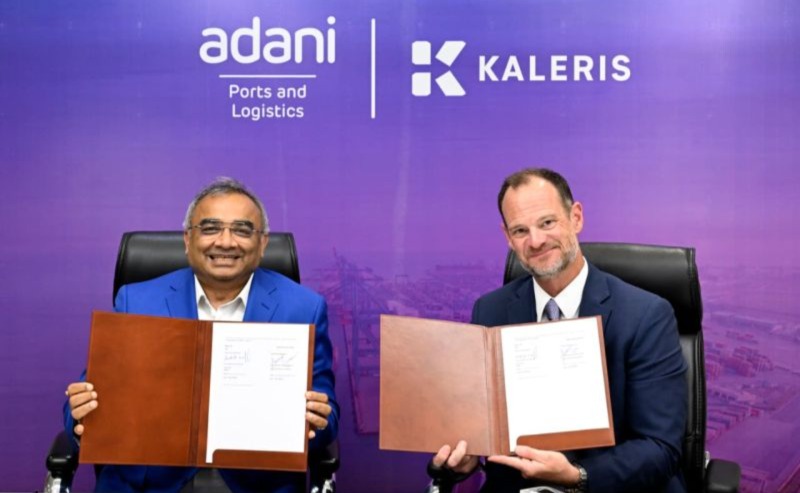
Adani Ports and Special Economic Zone (APSEZ) will invest up to $100 million in a two-phase rollout of an AI-enabled operating platform across 15 container terminals located at nine domestic and international ports, as part of its strategy to automate operations, enhance productivity and unlock additional cargo-handling capacity.
The initiative follows the expansion of APSEZ’s partnership with US-based supply chain software company Kaleris, which will deploy advanced terminal operating, optimisation and automation solutions across the port operator’s network. The investment is a component of APSEZ’s broader $850 million technology and decarbonisation programme through 2031, supporting its goal of handling one billion tonnes of cargo annually by 2030.
According to the company, the technology-driven transformation is expected to unlock an additional 91 million metric tonnes (MMT) of capacity by 2030—equivalent to nearly 10 per cent of its installed capacity—through operational efficiencies, improved asset utilisation and enhanced planning capabilities.
Under the expanded agreement, Kaleris will implement its N4 Terminal Operating System and Advanced Optimization Platform across APSEZ’s 15 container terminals, extending a previous deployment that covered six ports. The platform leverages artificial intelligence, advanced analytics and optimisation tools to streamline yard planning, container movements and equipment deployment.
“AI-enabled automation will define the next frontier of competitiveness in ports and logistics,” said Ashwani Gupta, Whole-time Director and Chief Executive Officer of APSEZ. He noted that the company’s existing end-to-end digital platform already provides integrated track-and-trace and command-and-control capabilities, while the Kaleris integration will further improve productivity, turnaround times and customer experience.
APSEZ expects the new system to deliver significant operational gains, including up to 20 per cent higher productivity for rubber-tyred gantry (RTG) cranes and up to 14 per cent improvement in terminal truck productivity. The enhanced platform is also expected to improve yard utilisation, planning accuracy and operational visibility across the network.
APSEZ currently operates 15 ports and terminals across India and four international ports in Australia, Sri Lanka, Israel and Tanzania, with a total cargo-handling capacity of 653 million tonnes per annum. The company handles nearly 27 per cent of India’s total port cargo volumes, making it the country’s largest private port operator.