
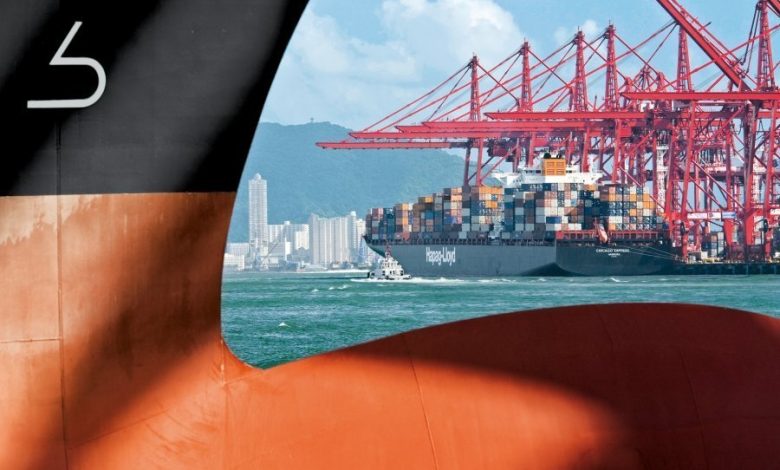
Global shipping companies are cautiously reassessing operations in the Persian Gulf following the announcement of a peace understanding between Iran and the United States, raising hopes of improved security in one of the world’s most critical maritime corridors.
Major container carriers including Maersk and Hapag-Lloyd have welcomed the development but emphasized that operational decisions will depend on a detailed evaluation of the evolving security environment.
“The latest developments give reason to hope that the security situation in the Strait of Hormuz will improve,” a Hapag-Lloyd spokesperson said. “We are reviewing the available information and are in close contact with the relevant authorities and our security partners. Our risk assessment for the transit of Hapag-Lloyd vessels through the Strait of Hormuz is currently under re-evaluation.”
Maersk echoed a similar stance, noting that while the announcement is encouraging, it remains too early to determine its impact on maritime operations based on currently available information.
Hundreds of Vessels Await Clearance
The conflict that erupted in late February severely disrupted shipping activity in the Persian Gulf, leaving more than 600 vessels stranded in the region, including approximately 250 tankers. While the peace announcement has generated optimism across the maritime industry, shipowners and operators remain wary of resuming normal transit patterns too quickly.
Industry stakeholders continue to monitor developments closely amid concerns that the security situation could remain fragile despite diplomatic progress.
BIMCO Urges Continued Caution
Global shipping association BIMCO has warned that risks to commercial shipping remain significant and that vessel operators should continue exercising extreme caution.
“Due to lack of details and a history of overly optimistic reassurances, we believe the security situation for the shipping industry remains volatile, and we still consider it very risky for ships to commence transits at this point,” said Jakob Larsen, BIMCO’s Chief Safety and Security Officer.
He urged shipowners to maintain comprehensive risk assessments and called on all parties involved to prioritize the safety of seafarers.
Larsen also advocated for a coordinated framework to manage the eventual reopening of maritime traffic in the region.
“Ideally, the concept for resumption of maritime traffic would be directed by a neutral body like the UN,” he said. “Such a concept would clarify matters such as safe routes, traffic separation measures, sequencing of ships leaving the Gulf, reporting procedures, ship security requirements, naval protection arrangements and emergency response mechanisms.”
Key Trade Artery
The Strait of Hormuz handles a substantial share of global energy exports, making any disruption a major concern for international trade and energy markets. While the Iran–US understanding has improved sentiment across the shipping sector, operators are expected to await clearer security assurances before fully restoring traffic through the region.
For now, industry participants remain hopeful but cautious as they assess whether the diplomatic breakthrough can translate into sustained maritime stability.