
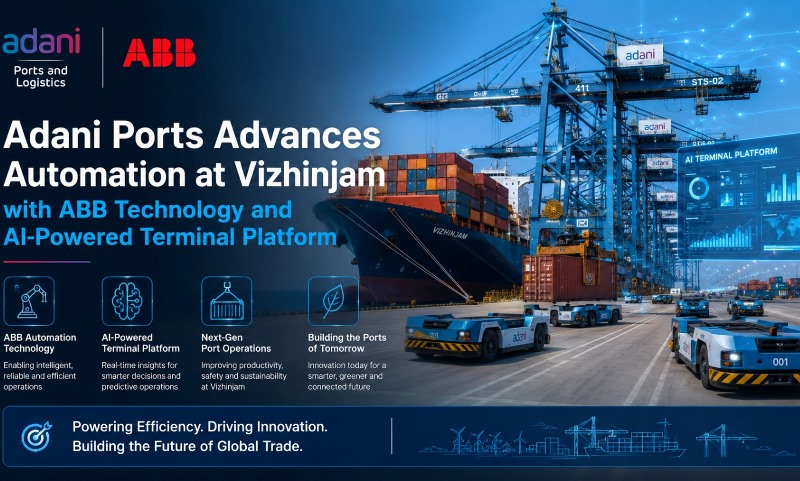
Adani Ports and Special Economic Zone Ltd. (APSEZ) is accelerating the digital transformation of India’s maritime sector with the deployment of fully automated container cranes at the Vizhinjam International Seaport in Kerala, reinforcing the port’s position as the country’s first fully automated container terminal.
The automation initiative, implemented in partnership with ABB, enables quay and yard cranes to be operated remotely from centralized, climate-controlled control rooms. Equipped with advanced automation and control systems, operators now manage crane movements through high-resolution screens and joystick controls, eliminating the need to work in crane cabins located 30 to 50 metres above ground.
The technology significantly enhances operational efficiency, safety, and worker comfort while helping double crane productivity compared to conventional operations. Although the introduction of the automated crane system was first announced around eight months ago, the project remains a landmark achievement for India’s port sector and a major milestone in South Asian maritime automation.
Vizhinjam’s emergence as India’s first fully automated container terminal is expected to strengthen the country’s ambitions of becoming a leading transshipment hub. Strategically located near major international shipping routes, the port is positioned to reduce India’s dependence on foreign transshipment hubs such as Port of Colombo and Port of Singapore.
In a parallel move to enhance terminal efficiency, APSEZ has expanded its partnership with Kaleris, a leading provider of terminal operating systems and supply chain execution software. Under the agreement, APSEZ will deploy an AI-augmented, plug-and-play operating platform across its network of 15 container terminals spanning nine ports.
The rollout includes the integration of Kaleris’ widely used Navis Terminal Operating System, aimed at improving operational visibility, optimizing asset utilization, and supporting data-driven decision-making across APSEZ’s container logistics network.
The combined deployment of advanced automation technology and AI-enabled terminal management systems underscores APSEZ’s commitment to building next-generation port infrastructure while enhancing India’s competitiveness in global maritime trade and logistics.