
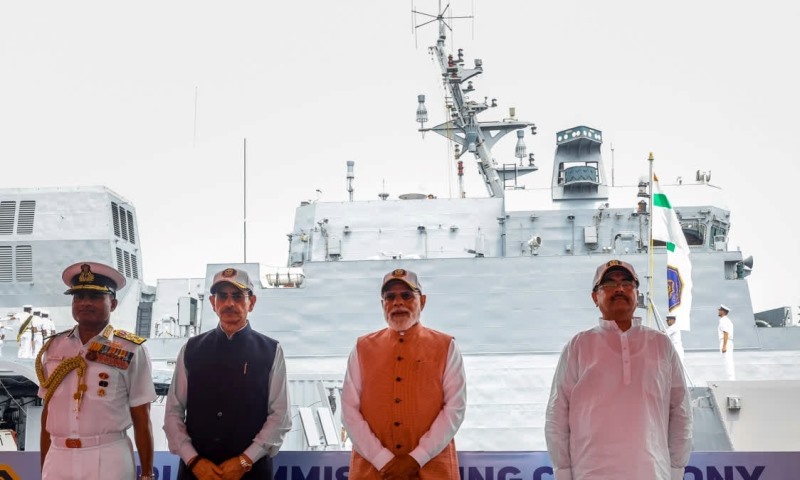
Prime Minister Narendra Modi on Sunday commissioned three indigenously designed and built naval platforms—INS Dunagiri, INS Sanshodhak, and INS Agray—at the Syama Prasad Mookerjee Port in Kolkata, underscoring India’s growing maritime strength and commitment to self-reliance in defence manufacturing.
Addressing the commissioning ceremony, Modi said strong maritime capabilities are critical to a nation’s economic and strategic influence, adding that India is steadily positioning itself as both a creator and a decision-maker in the global maritime sector.
“India aspires to be a Nirmata (creator), and as a creator, we will also become Nirnayak (decisive). We are moving rapidly in this direction,” the Prime Minister said.
Highlighting the country’s indigenous defence production achievements, Modi noted that more than 40 Made-in-India warships and submarines have joined the Indian Navy in recent years, while 45 major naval platforms are currently under construction.
“This means the Indian Navy gains a new strength almost every few weeks. It is not just a number; it is a testament to India’s industrial capacity and a sign of India’s future,” he said.
The Prime Minister reiterated that India does not want to remain merely a buyer in the global defence market. “The recognition of our capabilities lies in our self-reliance and not in becoming a market for the world,” he stated.
Emphasising the strategic importance of the maritime domain, Modi said no country can emerge as a major power without strong maritime capabilities. “Development, security and prosperity are tied to the seas,” he remarked, describing the newly commissioned vessels as critical assets that will enhance India’s maritime combat, hydrographic survey and anti-submarine warfare capabilities.
The three vessels were designed by the Indian Navy’s Warship Design Bureau and built by Kolkata-based defence PSU Garden Reach Shipbuilders & Engineers Ltd. (GRSE).
INS Dunagiri, the fifth Project 17A stealth frigate, is equipped with advanced weapons and sensors, including BrahMos surface-to-surface missiles and the Medium Range Surface-to-Air Missile (MRSAM) system, significantly boosting the Navy’s combat capabilities.
INS Sanshodhak, the fourth Survey Vessel (Large), is designed for coastal and deep-water hydrographic surveys and the collection of oceanographic and geophysical data for both defence and civilian applications. The vessel is equipped with advanced survey systems, including Autonomous Underwater Vehicles (AUVs) and Remotely Operated Vehicles (ROVs).
INS Agray, the fourth Arnala-class Anti-Submarine Warfare Shallow Water Craft, features lightweight torpedoes, indigenous rocket launchers and shallow-water sonar systems designed to detect and engage underwater threats in littoral waters.
According to officials, the three platforms contain more than 75 per cent indigenous content and were built with extensive participation from Indian industry, including over 200 MSMEs.
The commissioning ceremony was attended by West Bengal Governor R. N. Ravi, Leader of Opposition in West Bengal Assembly Suvendu Adhikari, and Indian Navy Chief Admiral Krishna Swaminathan, among other dignitaries.
The induction of the three naval platforms marks another milestone in India’s drive towards defence self-reliance and maritime capability enhancement under the government’s vision of Atmanirbhar Bharat.