
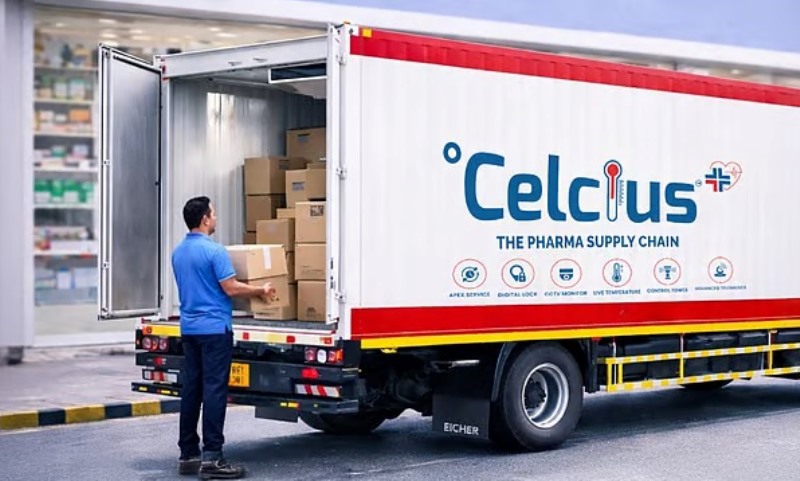
Cold chain logistics technology firm Celcius Logistics is on track to achieve its first profitable quarter as early as the next financial quarter, driven by robust demand across quick commerce, dairy, and perishable goods, even as infrastructure gaps continue to challenge the sector.
Founder and CEO Swarup Bose said the company is nearing an annual revenue run rate of ₹400 crore and expects to scale this to ₹550–600 crore next year. “We are very close to profitability and expect to achieve our first profitable quarter next quarter,” Bose noted, adding that Celcius has consistently doubled its run rate over the past five years.
The company has significantly expanded its footprint, now operating in nearly 700 cities, up from over 500 last year. Its network includes more than 150 warehousing and distribution centres, over 4,000 vehicles, and 300 hyperlocal riders across seven cities. Celcius employs around 400 people directly, supported by more than 1,000 contractual staff.
Positioning itself as an end-to-end cold supply chain provider, Celcius manages the entire value chain—from farm-level collection and pre-cooling to warehousing, multimodal transportation, and last-mile delivery. Its client base spans large corporates and emerging startups across pharmaceuticals, food and beverages, HoReCa, and e-commerce.
Looking ahead, the company is targeting an IPO within the next three to four years, while advocating for greater investment in India’s cold chain infrastructure. Bose highlighted persistent structural bottlenecks, noting that the country lacks sufficient cold storage capacity, refrigerated vehicles, and distribution hubs. This shortfall is particularly acute in agriculture, where nearly 50% of produce requires cold chain support, yet penetration remains limited—resulting in high wastage and elevated consumer prices.
Demand for cold chain logistics has been rising steadily, fuelled by evolving consumer expectations and the rapid growth of quick commerce. Bose observed that post-pandemic, quality sensitivity among consumers has increased significantly, prompting companies to invest more in efficient supply chains.
Quick commerce and dairy currently account for the largest share of Celcius’ revenue. The rise of instant delivery platforms has also transformed distribution models, necessitating faster and more reliable logistics solutions. To meet these demands, Celcius leverages air cargo for highly perishable goods, enabling inter-state deliveries within 12 hours for quick commerce dark stores.
A key growth driver for the sector is the increasing penetration into tier 2 and tier 3 markets. “The next phase of expansion in Bharat is in tier 2 and tier 3 cities,” Bose said, noting strong client demand as the company enters new geographies.
To support its expansion and improve operational efficiency, Celcius has ramped up investments over the past year. It has added more than 50 distribution hubs, expanded into over 200 additional cities, and invested heavily in advanced inventory and driver management systems.
Sustainability is also a major focus. The company has invested approximately ₹50 crore in electrifying last-mile delivery and currently operates over 200 electric refrigerated vehicles, with plans to scale this to more than 500 by year-end. Celcius aims to fully electrify last-mile operations and largely electrify mid-mile logistics by 2030, although long-haul transport continues to rely on conventional fuels.
Despite strong growth, external risks remain. Extreme weather events, such as last year’s prolonged monsoon and flooding, have disrupted supply chains, forcing companies to adjust production and distribution strategies. Additionally, geopolitical tensions in West Asia pose potential risks to fuel availability, although Bose expects companies dealing in perishables to absorb part of the cost pressures to maintain continuity.
Overall, Celcius Logistics’ trajectory reflects both the growing demand for temperature-controlled supply chains in India and the urgent need for infrastructure development to support the sector’s long-term growth.