
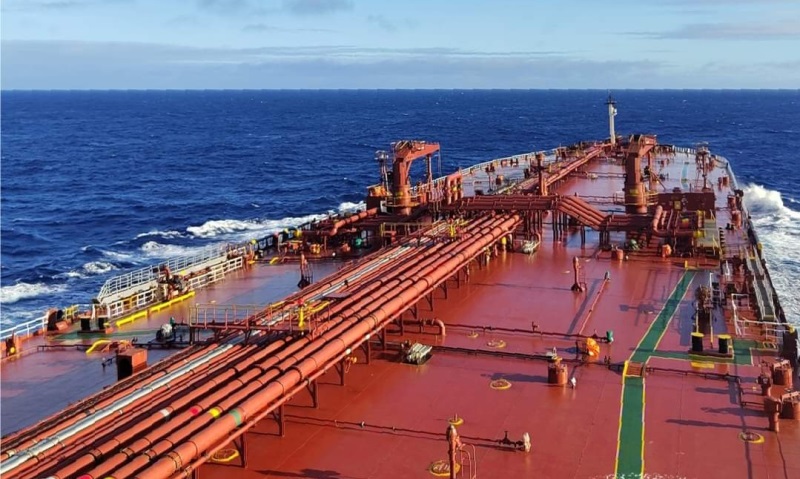
The global crude tanker order book has surged to a nine-year high, raising expectations of accelerated fleet renewal even as long-term oil demand forecasts weaken, according to BIMCO.
“Due to low contracting volumes in 2022, the crude tanker order book/fleet ratio bottomed out at 2.8% in March 2023. It has climbed steadily since and has now hit a nine-year high of 14.1%. The order book may kickstart the renewal of a fleet that has grown older on average since 2018,” said Niels Rasmussen, Chief Shipping Analyst at BIMCO.
Since 2023, shipowners have placed orders for 325 crude tankers with a combined deadweight capacity of 68.7 million tonnes. The current order book contains 309 vessels totalling 65.8 million DWT.
China, South Korea and Japan continue to dominate global tanker construction. Chinese shipyards account for 60% of crude tanker capacity on order, followed by South Korea at 31% and Japan at 8%, while the Philippines, Russia and Iran collectively hold the remaining 2%.
Deliveries are projected to peak in 2027 at 28.2 million DWT, with 98% of the existing order book scheduled to be completed by the end of 2028. Suezmax and VLCC segments lead the pipeline with 135 and 128 vessels respectively.
However, the pace of newbuilding activity appears at odds with long-term oil demand projections. The International Energy Agency’s latest World Energy Outlook expects global oil demand to grow by a maximum of 0.7% annually between 2024 and 2035. Under the IEA’s Stated Policies Scenario, growth could slow to 0.2% annually, while in a scenario aligned with the Paris Agreement’s 1.5°C target, demand could contract by 3.3% per year.
This makes fleet renewal, rather than expansion, critical. Currently, 18.2% of the global crude tanker fleet is 20 years or older, representing 17.2% of total DWT—slightly exceeding the order book’s replacement potential.
“Despite the relatively large order book and potentially weak demand growth, it appears likely that the market can achieve a balanced supply/demand if older ships are recycled,” Rasmussen noted. “However, we estimate that more than 40% of the recycling potential comes from currently sanctioned ships. The sanctions restrict the selling of these ships, which may delay recycling and potentially result in lower scrap prices than for unsanctioned vessels.”
Industry observers say the interplay between new deliveries, recycling delays and tightening environmental regulations will shape the tanker market’s trajectory through the next decade.