
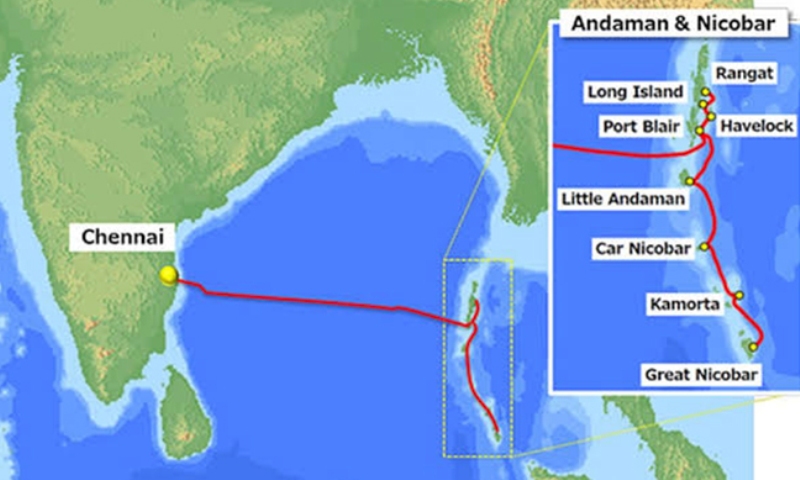
The ambitious Great Nicobar Island development project is poised to become a transformative force in India’s maritime sector, positioning the Andaman and Nicobar Islands as a major logistics and transshipment hub in the Indo-Pacific region, Lieutenant Governor D.K. Joshi has said.
Speaking to PTI, Joshi highlighted that the project is entering the implementation phase, with the International Container Transshipment Terminal (ICTT) emerging as its flagship component. The first phase of the terminal is expected to handle around 6 million TEUs (twenty-foot equivalent units) at an estimated investment of ₹20,000 crore and is targeted for completion within three years of commencement.
“In the final phase, the terminal’s capacity could reach 21 million TEUs, making it one of the largest container ports not only in India but potentially across the Indo-Pacific,” Joshi said.
Located strategically near the Malacca Strait, one of the world’s busiest shipping corridors, Great Nicobar is expected to emerge as a dominant transshipment hub, enhancing India’s role in global maritime trade and reducing dependence on foreign ports for container transshipment.
The project will be implemented under a public-private partnership (PPP) model, with authorities emphasizing a balanced approach that combines port-led economic growth with environmental safeguards and protection of indigenous communities.
The development plan also includes a greenfield international airport, with at least one runway expected to become operational within three years. Simultaneously, the runway at INS Baaz in Campbell Bay is being extended to nearly three kilometres to accommodate larger aircraft.
Joshi said these initiatives would significantly strengthen the economic and strategic importance of the Andaman and Nicobar Islands and contribute to India’s broader vision of becoming a developed nation under the “Viksit Bharat” framework.
In addition to the Great Nicobar project, the administration is pursuing several complementary maritime initiatives. Agreements have been signed with Cochin Shipyard Ltd. for skill development and infrastructure enhancement aimed at boosting ship repair capabilities in the islands.
Other projects under consideration include a ship-to-ship transshipment terminal at Port Meadows off Swaraj Dweep and a deep-water multipurpose port at Atlanta Bay near Diglipur. These developments are expected to support growing maritime activity in the region.
“Shipping activity in the Andaman seas is expected to increase significantly over the next five years, enabling the region to evolve first into a ship repair hub and eventually into a shipbuilding centre,” Joshi said.
However, the Great Nicobar project has also attracted criticism from environmental groups and political opponents. The Congress party has raised concerns that the development could lead to ecological damage, including the destruction of coral colonies and sensitive island ecosystems.
Officials said multiple studies are currently underway and the projects will be implemented in phases over the coming years.