
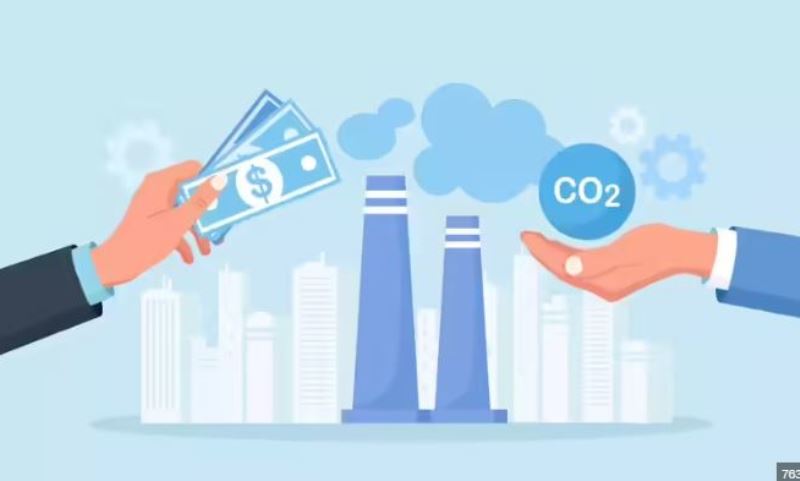
The Indian government has recently introduced greenhouse gas (GHG) emissions intensity targets for eight energy‑intensive industrial sectors—including steel, cement, aluminium, textiles, petrochemicals, oil refineries, paper & pulp, and chlor‑alkali—under its Carbon Credit Trading Scheme (CCTS).
Launching in 2023 via the Energy Conservation (Amendment) Act, it aims to curb emissions and reward entities that outperform benchmarks by issuing tradable carbon credit certificates, while allowing laggards to buy credits or face penalties.
The scheme is modeled loosely on the PAT (Perform, Achieve, Trade) mechanism, which successfully cut energy intensity across covered sectors by enabling high performers to sell efficiency certificates and others to comply via purchases.
However, assessments of the earlier PAT cycles revealed mixed results at the plant level, despite achieving aggregate reductions in energy intensity.
The heart of the critique: CCTS’s current targets aim for only a ~1.68% annual decline in emissions intensity from 2023–24 to 2026–27—less ambitious than the projected industry-wide decline of ~2.53% and significantly less than the power sector’s 3.44% annual reduction needed for alignment with India’s net‑zero ambitions.
This disparity suggests that while well‑intentioned, CCTS targets may not be stringent enough to meet both India’s 2030 NDCs (45% reduction in emissions intensity vs. 2005) and its 2070 net‑zero roadmap.
Moreover, CCTS presently excludes key sectors like power, transport, agriculture, MSMEs, and thermal plants—limiting its economy-wide impact.
Critics argue for a shift away from merely sector/entity‑level compliance toward an economy‑wide evaluation to truly measure environmental ambition and success.
Looking ahead, experts recommend tightening targets progressively, expanding sectoral coverage, integrating international best practices for robust monitoring, and linking CCTS trajectories directly to NDC and net‑zero modeling. Only then can it evolve into a meaningful tool for India’s decarbonization journey.