
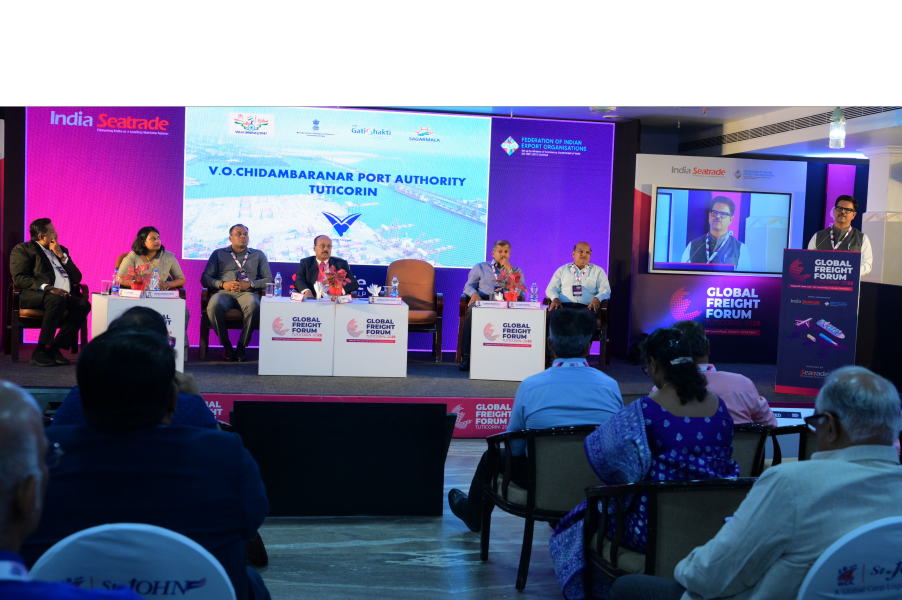
“The Port is fully geared up to meet the trade demand,” Susanta Kumar Purohit, Chairperson, VOC Port Authority
The India Seatrade Global Freight Forum 2025, held in Tuticorin and jointly organized by the Federation of Indian Export Organisations (FIEO), saw large-scale participation from the EXIM trade. The maiden event by India Seatrade at Tuticorin witnessed participation by shipping lines, terminal operators, freight forwarders, and NVOCC agents who reposed their full trust in utilising the port’s services.
Delivering the keynote address, K Mohandas, chairman of India Seatrade, said, VOC Port is of historical importance. The port is reorienting itself as a smart business entity. This is to respond to the present trade demand through adaption off newer technologies and operating processes. However, to utilise the advanced levels of services of the port, it will be vital for the trade to work in coherence with the trade and other stakeholders of the port.”
Addressing the India Seatrade Global Freight Forum Tuticorin 2025, Susanta Kumar Purohit, Chairperson, VOC Port Authority, shared details on the port’s long-term preparedness to cater to the business interests of the trade, all with the focus of making the port cost-effective in its operations.
“VOC Port is an all-weather port. Being in a rocky basin, we have undertaken one-time capital dredging. This contrasts with the regular maintenance dredging. This makes us a cost-competitive port. The port’s operating ratio of 29 percent further makes us cost-effective. Working further towards making business viable for the trade, we are the sole port that has gone for the adoption of green hydrogen as a pilot project, with 20 kg of green hydrogen being produced. This is being used for the illumination of the streets of the port’s colony. We are fully committed to the container business through our continued proactive association with two container terminals at the port. Working on a broader spectrum, we are working on our Vision 2030 plan. Following this, we are positioning ourselves as a multi-cargo port through the optimum utilisation of our 16 berths. Our major initiative in this direction is the development of the much-awaited outer harbour project at the entrance of the port channel. Despite having a lucrative proposition for the bidders, we did not have the desired participation of bidders. We are now looking to make the project attractive for the bidders. This is through provision for minimum traffic guarantee concession and revenue sharing following the 11th year of operations. The retendering process for the outer harbour will begin in another 3-4 months. Tendering for berth No. 10 is in its final stages.
We are in the process of strengthening berths Nos 3,4, and 7. We have commenced operations on NCB berth No. 3. For optimising our operations, we have recently commissioned a new conveyor belt link connecting the NCB berth No. 3. The port has an adequate capacity of 81 million tons, of which 41.72 million tons of capacity is presently being used. With an aim to make VOC Port an eco-friendly cargo entity, we are working towards solid waste management. The port enjoys a major position for handling windmill blades. Being termed as a waste-to-wealth reality, the policy emphasizes utilising residual building materials. The port is actively looking forward to developing the windmill business. This is through setting up an offshore wind business.” Mr Purohit said, “We will continue to engage with the trade. This will be through business meetings in various parts of the country. This is to make the existing and potential users use VOC Port,” Mr Purohit stated.
Speaking at the event, Iswarya Sankaralingam, Director, PSS Krishnamurthi Exports, said, “There has been a rapid surge in India’s exports during 2024-2025. However, there have been restrictive trade practices from the US and Europe, with new tariff barriers and testing standards to be precise for textiles. This has made it vital to adapt digitization in operations to integrate with the supply chain. This also requires investment in quality infrastructure. VOC Port, to orient to the newer supply chain arrangements, has gone for process automation with plans for critical infrastructure expansion.”
D.R. Kodeeswaran, President, Indian Chambers of Commerce & Industry, Tuticorin, said, “Tuticorin is emerging rapidly as an industrial hub, and the port will be the preferred gateway to cater to the trade needs. This is due to its strategic location. However, to have its share of the EXIM pie, the port will need to upgrade its existing infrastructure and build up newer infrastructure.”
Rajesh Kumar, President, Customs Broker & Shipping Agents, Coimbatore, citing the potential to utilise the services from Coimbatore EXIM trade, said, “Coimbatore is a fast-emerging EXIM industrial cluster. However, there are requirements for putting up ICDs to cater to the EXIM trade for the containers originating from Coimbatore. Further, there will be a requirement to be given to the CFS and ICD. For the trade to fully avail itself of the services of Tuticorin Port, it will be important to have regular rail services to the port.”
Shankar Marimuthu, President, All India Chambers of Commerce and Industry, said, “VOC is the preferred gateway for global opportunities. It will be vital for the port to have very strong engagements with stakeholders, particularly the Customs, for smoother operations.”
Deliberating on VOC Port’s potential and its unique selling proposition, Subhash Rajkumar-General Manager Operations, Hapag Lloyd AG, said, “VOC Port offers fair levels of potential for the shipping lines. However, to make operations fully viable for the shipping lines and enable them to pass on the benefits to the trade, there is a foremost requirement of adequate volumes of business.” He felt that, although Vizhinjam terminal in Kerala has emerged as a transhipment hub, it should not pose any threat to VOC Port as there are adequate levels of business from the hinterland.”
Catering to the business need of the trade, G. Gayatri, Area Head, Area III, CONCOR said, “Concor is presently multimodal level service provider. To facilitate the trade, we have started to move LNG trucks to Madurai. Trucks are being placed to Coimbatore, Mysore new EXIM terminal,” she said, “The southern hinterland is narrow with shorter lead distances. This does not make the railway freight movement fully viable. Further, there are requirements of cargo aggregation.”
Kumar Duraiswamy, CEO of Eastern Global Clothing & Joint Secretary, Tirupur Exporters Association (TEA), making the case for the VOC port, said, “There have been challenges for TEA. However, there has been a rebound in growth in 2024-2025 by almost 20 percent as compared to the previous year. A good number of association members have signed FTAs with Europe, five textiles parks are being announced by the government, and further, the exporters are expanding their existing production capacities. This will make it more likely to avail of the services of the VOC port. The attraction of the Tirupur trade toward the VOC is due to the conducive ecosystem and ease of doing business at the port.”
During a discussion on the challenges in expanding the port’s capacity and the preparedness of the port towards capacity expansion, Rajesh Soundarajan, Deputy Chairman, VOC Port Authority said, “We are adding up to the capacity to cater to the trade requirements, The port is coming up with outer harbour expansion and widening of the port mouth. This will create additional capacity and enable the port to accommodate bigger and longer vessels. Further capacity is being done through the strengthening of berths number 3,4,7. Besides, tendering for berth number 10 to handle multi-cargo is being finalised.”
 Senthilkumar Subramaniam, CEO, Dakshin Bharat Gateway Terminal, said, “There are 14 container terminals in South India. The terminals together have done handling of 2.8 million TEUs in 2024-2025, up from 2.3 million TEUs in 2023-2024. PSA and DP World terminal at Chennai Port has done remarkably well with 20 percent growth. However, with the emergence of the Vizhinjam Terminal in Kerala, there has been erosion
in the transhipment business. For the VOC Port to be operational, there will be a requirement to tap the captive cargo. The port will have an opportunity to tap transhipment business, as the neighbouring transhipment ports are facing congestion.”
The speakers concluded that it will be vital for the port and the trade to work in coherence, with the port fully committed to meeting the trade demand and expectations. There will be requirements for the freight tariff rationalisation and other initiatives.