
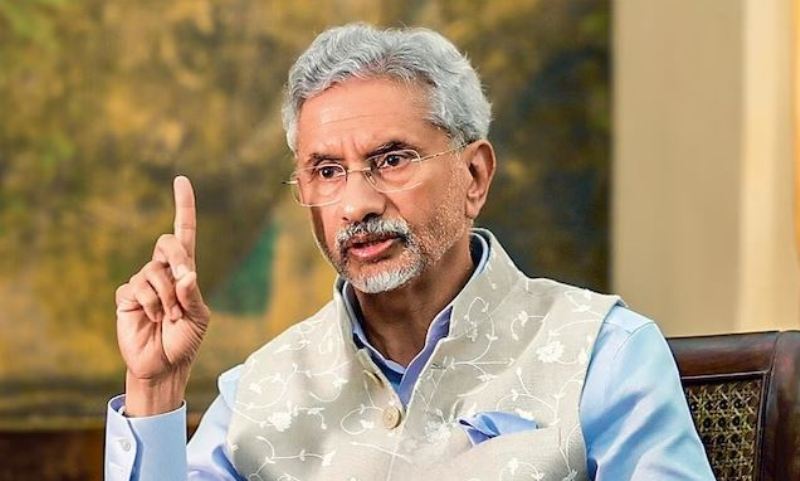
The Union Government of the Republic of India is making efforts to strengthen cooperation in the digital domain, ensuring supply chain and addressing the impact of climate change with countries across the Indo-Pacific region for economic reforms, said Dr Subrahmanyam Jaishankar, Minister of External Affairs of India.
Addressing journalists from 28 countries across the Indo-Pacific region including Cambodia, Jaishankar said that the Quad is essentially an initiative of all the countries that are located in different corners of the Indo-Pacific region to address the specific business goods toward the last few decades due to the capacity of countries have changed and the challenges the world faced have evolves.
Randhir Jaiswal, Joint Secretary and Official Spokesperson of the Ministry of External Affairs of India was present on the occasion.
The Minister of External Affairs of India continued by saying that the issues including maritime shipping, disasters, climate change, supply chain and pandemics as these are all common global problems which have a particular intensity in the current world.
“In a world of greater stress, the idea that could help and collaboratively support each other is crucial to defining rights and obligations.”
“As the world changes, new challenges have come and the supply chain has shifted hence we need to create a resilient community, strengthen cooperation, develop infrastructure and promote better communication for the digital domain as each country begins to realise how important it is to have trusted partners where the data that is shared will be handled safely,” he added.
The following day, the Observer Research Foundation (ORF) organised a meeting chaired by Harsh V. Pant, Vice President of Studies & Foreign Policy of ORF aimed at addressing the challenges and geopolitical tension in the South China Sea by conducting in-depth research , providing inclusive platforms and invest in leaders’ thought.
During the discussion, Pant briefed the background of ORF which began in 1990 at the juncture of creativity tempered by pragmatism hence during India’s transition to a new engagement with the international economic order, several challenges emerged, evoking a need for an independent forum that could critically examine the country’s problems and help develop coherent policy responses.
When Khmer Times asked about how India intends to maintain the balance in Cambodia despite China’s engagement, Pant said, “Obviously, we should not challenge China based on the financial play, a dollar for a dollar, but we can make use of the resources and expertise along with the well-management system to redirect the financial flow to the needed and necessary sectors.”
“What India can offer to Cambodia is the development of digital infrastructure as we specialise in terms of technology and digital platforms,” the ORF Vice-President added.
Abhishek Sharma, a Research Assistant of the Strategic Studies Programme of ORF and Sayantan Haldar, a Research Assistant of ORF, were present on the occasion.
According to ORF, it was formed, for the first time, with leading Indian economists and policymakers to present the agenda for India’s economic reforms.
The foundation is supported in its mission by leading intellectuals, academicians, policymakers, business leaders, institutions and civil society actors.
As new powers re-emerge on the global stage, existing systems face the challenges of agreeing on a new set of rules to control while regulating the new frontiers of space, the oceans, the internet and the human mind.
The world also continues to navigate persisting concerns related to security and strategy, economy and development, energy and resources, the statement said.
As India begins to play a larger role in the 21st century, ORF continues to push normative boundaries, bring new ideas into the policy discourse and provide a platform to a new generation of thinkers.