
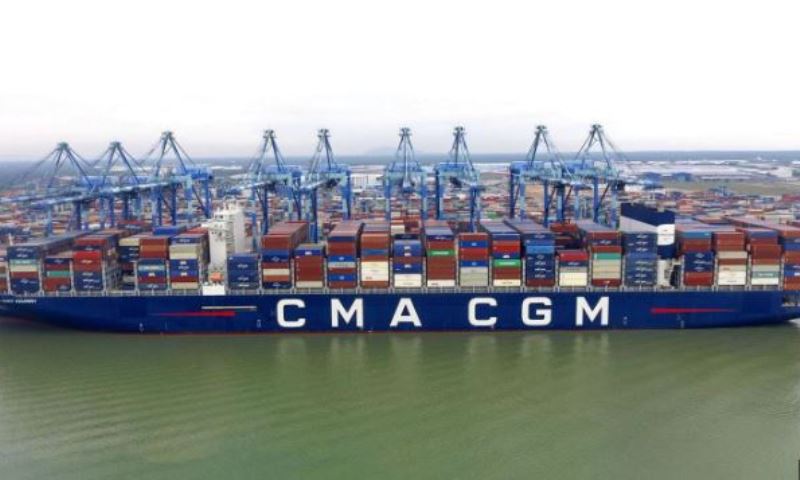
Maritime connectivity between Saudi Arabia and key Asian and European markets is set to strengthen following the addition of CMA CGM’s “Ocean Rise” shipping service at Jeddah Islamic Port.
The new service links Jeddah with major ports across Asia and Europe, including Kobe, Nagoya and Yokohama in Japan; Xiamen, Yantian and Nansha in China; as well as Rotterdam, Hamburg and Southampton. With a handling capacity of up to 3,001 TEUs, the route is expected to support the efficient movement of Saudi exports and imports in partnership with global shipping lines.
Saudi Arabia’s Ports Authority, Mawani, said the addition forms part of its broader strategy to enhance maritime connectivity and improve the Kingdom’s standing in global logistics performance indicators. The move aligns with the objectives of National Transport and Logistics Strategy, which aims to position Saudi Arabia as a global logistics hub linking Asia, Europe and Africa.
Mawani noted that 18 new maritime services have been launched recently, offering a combined handling capacity of 123,552 TEUs. The expansion is being driven in collaboration with leading global carriers such as MSC, Maersk, PIL, CMA CGM and Hapag-Lloyd.
The authority added that these efforts are focused on improving supply chain resilience, ensuring efficient cargo movement, and strengthening operational readiness across Saudi ports.
Earlier in March, Mawani introduced five additional services—Gulf Shuttle, Redex, Jade, AE19 and SE4—operated by major carriers including Maersk, Hapag-Lloyd, MSC and CMA CGM. These routes, with a combined capacity of 63,594 TEUs, were launched to enhance trade connectivity and mitigate disruptions in key maritime corridors such as the Strait of Hormuz.
Saudi ports have recorded steady growth, with cargo throughput rising 6.66 percent year-on-year in March. Mawani-operated ports handled 667,882 TEUs in February, marking a 20.89 percent increase compared to the same period last year.
A key maritime gateway, Jeddah Islamic Port features 62 multi-purpose berths, two container terminals, a logistics park for warehousing and re-export, and advanced handling infrastructure. The port has a total capacity of up to 130 million tonnes, supporting Saudi Arabia’s expanding role in global trade under Vision 2030.