
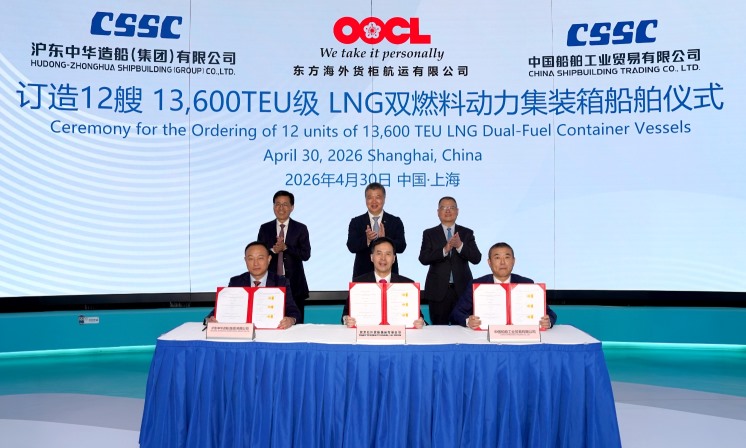
Orient Overseas Container Line Ltd. (OOCL) has announced an order for twelve 13,600 TEU class LNG dual-fuel container vessels, marking a significant step in its strategy to advance low-carbon shipping and support the maritime industry’s energy transition.
The company signed shipbuilding contracts with Hudong-Zhonghua Shipbuilding (Group) Co., Ltd. on April 29, 2026. These vessels will feature dual-fuel main engine systems capable of operating on both liquefied natural gas (LNG) and conventional marine fuels. Upon delivery, they will be the first LNG-powered vessels to join OOCL’s fleet.
The move reflects OOCL’s strategic response to evolving environmental regulations, growing adoption of alternative fuels, and the increasing importance of sustainable operations across global shipping. The company noted that the decision followed a comprehensive assessment of regulatory trends, fuel availability, and technological readiness.
Tao Weidong, Chief Executive Officer of OOCL, stated that the order underscores the company’s commitment to sustainable development while maintaining operational flexibility through fleet diversification. He added that the additional capacity will enable OOCL to strengthen its presence in emerging, regional, and third-country markets.
With the expansion, OOCL aims to optimize its global capacity deployment, enhance service reliability, and better meet the long-term and diverse transportation needs of its customers, while aligning with international decarbonization goals in the shipping sector.