
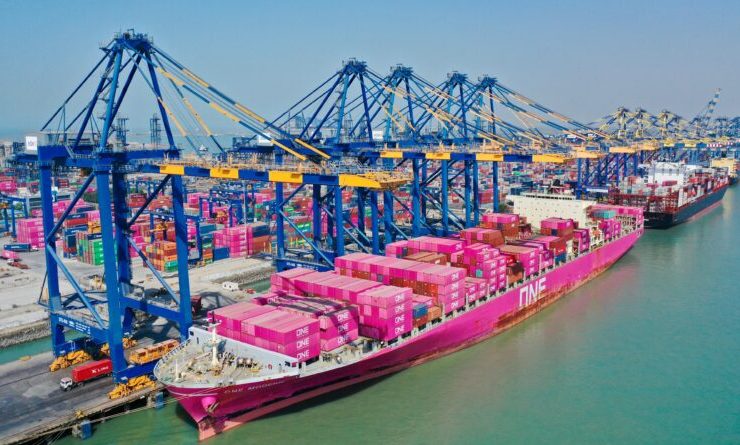
Black-outs and disruptions in trade traffic due to ‘Operation Sindoor’ — the military action carried out by India against terrorist infrastructure in Pakistan in May 2025 — saw cargo volumes at Mundra port in Gujarat drop by 6.2 per cent in the first quarter of the current financial year 2026.
However, at the neighbouring Kandla port, cargo volumes clocked a growth.
“In the last quarter, two things had a negative impact on our overall (cargo) volumes… The biggest cause that affected Mundra was geopolitics, and some of the nights we had to close the port, because of the black outs,” said Ashwani Gupta, Whole-time Director & CEO, Adani Ports and Special Economic Zone Ltd (APSEZ) while referring to the temporary stoppage of cargo handling at the Mundra port during the Operation Sindoor when enemy drones were sighted near the international border in Gujarat.
“Secondly, because of the restrictions imposed by the Union government on Pakistan — as a consequence of Operation Sindoor — shipping routes were disturbed, because Mundra is the last port call before our neighbouring country. So, when we disturb the trade traffic, it takes time to adjust. It happened in May and it (cargo volumes) started improving in June. In July, we have seen the container volumes in Mundra coming back and we are 10 per cent more than what we did in June,” Gutpa added during an earning’s call held earlier this week.
Interestingly, Kandla port — a major port located next to Mundra in Gulf of Kutch in Gujarat — saw a 5.3 per cent growth in cargo volumes during Q1 of FY26 despite the port shutdowns caused due to Operation Sindoor. Kandla located about 70 kilometres from Mundra handled 37.9 million tonnes of cargo during the first quarter.
“Though the port operations at Kandla were affected during Operation Sindoor, we managed to recover later and achieve a growth,” a senior official from Deendayal Port Authority (DPA) at Kandla told businessline.
Meanwhile, Mundra port which handled 51.14 million tonnes of cargo during the first quarter of FY25, saw volumes decline to 47.96 million tonnes during the same period this fiscal.
Coal volumes handled at the port dipped by 18 per cent to 7.14 million tonnes from the 8.7 million tonnes the previous year. Similarly, container volumes also declined by three per cent to 30.72 million tonnes.
Crude volumes rise
However, liquid cargo handled by Mundra grew 14 per cent to 0.68 million tonnes and crude volumes rose by one per cent to 7.51 million tonnes. APSEZ officials pointed out that the decline in imported coal used by both Adani and Tata Group plants in Mundra and the poor fertilizer volumes also contributed to the decline in overall port volumes.
It is not just Mundra that registered a dip in cargo volumes in the first quarter. Other ports under the APSEZ umbrella including Dahej (-14 per cent), Kattupalli (-11 per cent), Ennore (-11 percent) saw a decline in cargo volumes.
On the other hand, ports like Gangavaram (76 per cent), Karaikal (21 per cent), Krishnapatnam (7 per cent), Dhamra (1 per cent) and Hazira (1 per cent) saw an increase in volumes during the first three months of the fiscal.
During the first quarter of FY26, APSEZ registered an 11 per cent growth in cargo volumes with its ports handling 120 million tonnes of cargo. The domestic ports registered a 6 per cent growth in cargo volumes (113 million tonnes), while the international port operations saw a 245 per cent growth in volumes (7.7 million tonnes).