
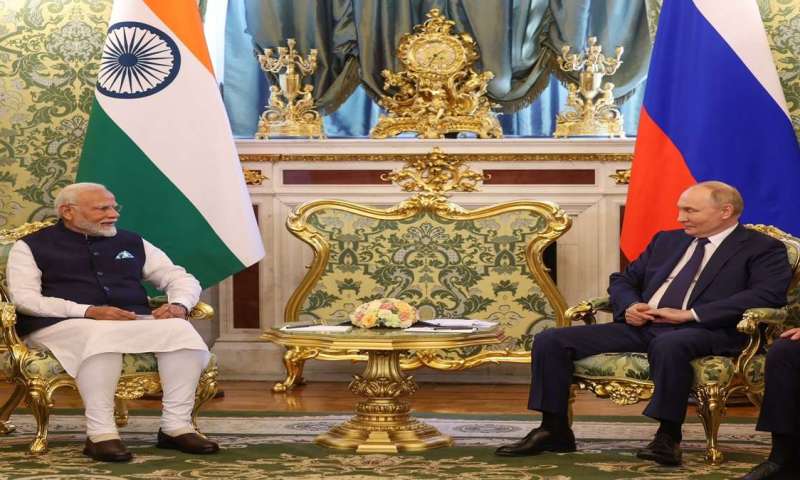
Russian President Vladimir Putin’s two-day State Visit to India has significantly expanded the Special and Privileged Strategic Partnership between the two countries, resulting in a wide-ranging set of agreements across maritime cooperation, economic security, labour mobility, healthcare, education, and cultural exchange.
In a major boost to maritime collaboration, India and Russia signed two MoUs aimed at strengthening cooperation in polar navigation, shipping, port infrastructure and maritime R&D. One agreement between India’s Ministry of Ports, Shipping & Waterways and Russia’s Ministry of Transport will facilitate specialised training for Indian seafarers operating in polar waters. A second MoU with the Maritime Board of the Russian Federation opens new avenues in shipping and mineral exploration, aligning with India’s blue economy priorities and its growing interest in the Arctic region.
Labour mobility emerged as another key pillar, with both countries finalising an agreement on the temporary movement of skilled Indian workers to Russia under an orderly, regulated framework. A parallel pact on combating irregular migration reinforces shared commitment to secure and legal cross-border movement.
Healthcare cooperation received a substantial push through an MoU between the two Health Ministries to enhance medical education, public health collaboration and scientific research. Additionally, India’s food safety authority and Russia’s consumer protection agency agreed to strengthen joint efforts on sanitary standards and food quality protocols.
Economic engagement witnessed important developments, particularly in the fertiliser sector. A joint venture between Russia’s JSC UralChem and three Indian public sector companies aims to establish urea production facilities in Russia, offering India long-term supply stability and reducing exposure to volatile global markets.
To ease bilateral trade, customs authorities of both nations signed a protocol for sharing pre-arrival data on goods and vehicles, a move expected to cut transaction costs and reduce delays. India Post and Russian Post also inked an agreement to strengthen logistics connectivity and support cross-border e-commerce.
Academic and scientific collaboration saw new momentum with the Defence Institute of Advanced Technology, Pune, signing agreements with Tomsk State University, and a trilateral pact between the University of Mumbai, Lomonosov Moscow State University and the Russian Direct Investment Fund to integrate education with industry requirements through joint research and student exchanges.
Beyond the bilateral outcomes, the visit underscored the broader geopolitical convergence between New Delhi and Moscow. Both countries reiterated support for a multipolar global order and called for stronger roles for platforms such as BRICS and the Shanghai Cooperation Organisation, signalling continued alignment on strategic autonomy amid shifting global dynamics.