
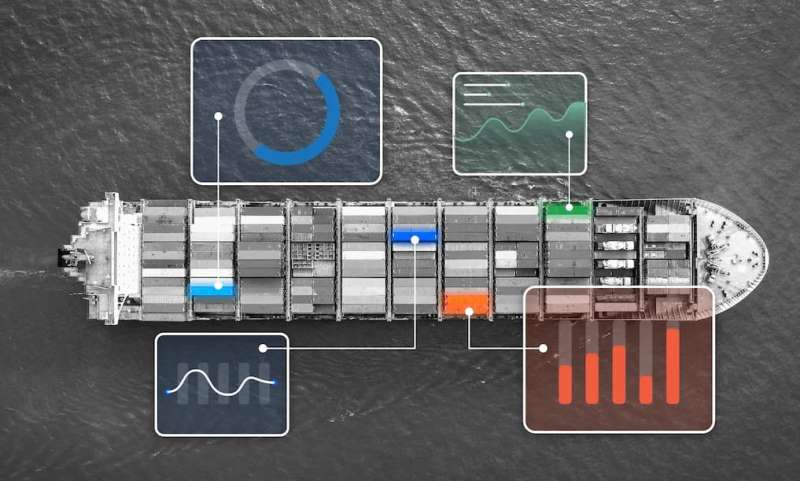
Hapag-Lloyd has “set the standard” for smart container usage, according to the Digital Container Shipping Association (DCSA), but it is yet to be seen if carriers can push these “expensive” costs to shippers.
The German carrier announced its full-year earnings yesterday and included the news that there were “newly installed tracking devices on almost all its containers” – around 1.7m of the approximately 1.9m standard and special fleet it owns.
However, Thomas Bagge, DCSA CEO, said adoption of smart containers across the industry was “uneven”.
“Hapag-Lloyd has equipped nearly all of its containers with IoT devices and other companies, such as MSC, has equipped about a quarter of a million of its reefer fleet, and Maersk, which has equipped almost all of its reefers. At the other end are companies that have taken few steps towards enabling their equipment with IoT devices,” he explained.
But even those well-equipped have “challenges”.
“Firstly, Maersk has a system that will allow you to track O2 levels, CO2 levels, shocks, temperatures, etc on your reefer container, but if that container is loaded on a Hapag-Lloyd ship, the container will not communicate with the Hapag-Lloyd vessel.”
Mr Bagge explained that this was not due to security or competition reasons, but “because the container shipping lines have not agreed on standards for container to vessel communication, so there’s no interoperability”.
Hapag Lloyd used cellular smart containers, “which basically works when the container, just like your phone, has connection to a cellular network”, he explained. This means that when a vessel is sailing, the cellular connection won’t work, but the carrier can track the vessel. Once discharged to truck or rail service, tracking the individual container resumes.
Mr Bagge said cellular smart containers were what the DCSA predicts many other carriers would adopt.
“But of course, if it’s cellular, there’s other limitations. When the box is on board the vessel, you won’t be able to detect temperature, O2, CO2, etc. you will be blind. If you look at the length of an Asia to Europe or across the Pacific route, it’s a significant part of the voyage that you won’t be able to monitor or potentially change those things,” he added.
To encompass everything a shipper might want in tracking their cargo, Mr Bagge warned, would be pricey.
“We did a ‘back of an envelope’ calculation, and barring all the potential challenges with battery life and all sorts of things, let’s say it’s $100 per device. If you have four million containers, then we are talking about $400m.
“And then you have just equipped them. You haven’t built the application layers, you haven’t built the spare parts, you haven’t trained your people. So very, very quickly, for a large carrier, this is going to be expensive.”
But he noted that Hapag-Lloyd, having equipped the majority of its dry containers, had “set a standard for the industry”, that others would have no choice but to follow.
“If you are a procurer of container shipping services, the most basic thing you need to know is where my container is’. It cannot be right that you can track your pizza deliveries, but you cannot track your container. It’s so lopsided that it will have to change,” explained Mr Bagge.
“But, of course, if you are running a container business, you are also going to consider your return on a $400m-$500m investment. Some are trying to charge for location services, we’ll see whether they’re successful or not,” he concluded.