
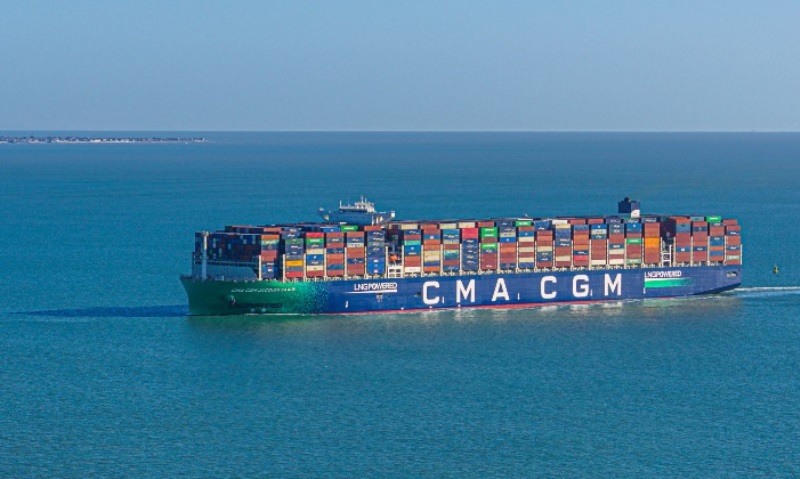
CMA CGM appears to be warming to new network partners on Indian trades to compete with mega-alliances, particularly the Gemini Cooperation of Maersk and Hapag-Lloyd.
According to industry sources, the French liner is set to phase-in vessels on a weekly Asia-India loop that Cosco currently runs as a standalone.
“CMA CGM is upgrading with deployment of two vessels,” one source said. “An announcement is expected shortly.”
CMA CGM has been a slot charterer on the service and its tonnage plan seemingly comes as part of new capacity strategies for the Indian market.
The carrier operates the intra-Asia loop as the AS6 (Asia Subcontinent Express 6), which has just been updated with a port change in India – replacing Pipavav with Mundra, starting from (the) OOCL Atlanta voyage 0KCBCE1MA, ETA Mundra 5 May.
From early May, the string will run on a rotation of Shanghai-Ningbo-Shekou-Nansha-Singapore-Port Klang-Nhava Sheva-Mundra-Karachi-Colombo-Singapore-Hong Kong-Shanghai.
The OOCL Atlanta is one of four ships Cosco deploys on the 42-day round-trip voyage, which requires six ships for a weekly frequency.
Cosco has tonnage and slot deals on some of CMA CGM’s services out of India, which includes the Epic, on the India-Europe trade. This leading vessel-sharing agreement (VSA) includes two ships from Cosco and one from its sister unit, OOCL.
Industry sources see the latest development as a sign of a closer collaboration between the two carriers amid growing overcapacity pressures, causing continuous rate erosion as carriers compete with each other for cargo volumes.
Hapag-Lloyd had been a long-time VSA partner of CMA CGM until the Gemini rollout, which has injected more capacity into Indian trades.
For the Indian market, Gemini includes two Europe strings with direct calls at Nhava Sheva and Mundra, and one South India-Europe connection, calling at Ennore port, near Chennai.
Capacity additions come amid a slowing trend in India’s export trade, with ongoing US tariff threats further darkening growth prospects.
For example, a 25% tariff announced yesterday by US president Donald Trump on automobile imports has added to that concern. While Indian auto manufacturers have a miniscule share in US finished car sourcing, they have a significant market in auto parts supplies to that country. These flows account for some 30% of India’s overall export trade, available data reveals.
India’s overall merchandise exports in February saw a sharp 11% decline in value terms, sparking alarm bells for industry stakeholders.
“There is a need for strategic measures to bolster exports and rationalise imports,” commented the Federation of Indian Export Organisations.
“It needs a focused approach to export diversification, targeting new markets and products, and for the continuation of trade facilitation measures and export incentives.”