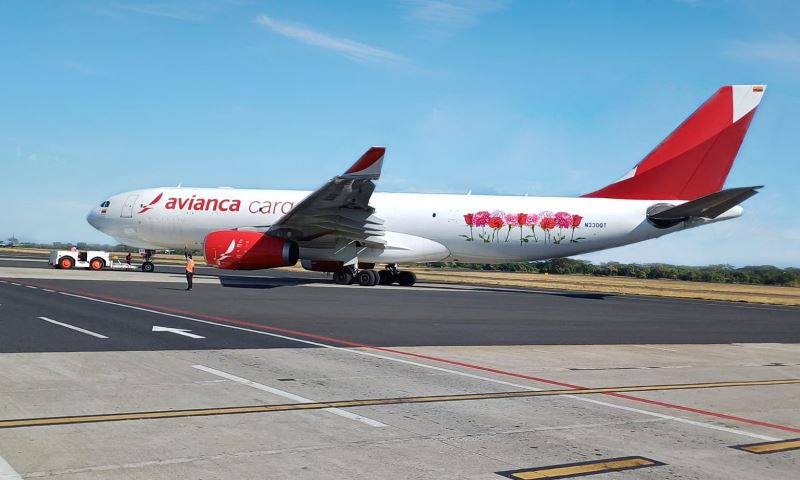
Avianca is expanding its freighter fleet, but the carrier’s latest push in the maindeck market features external capacity.
It is using a B777F from Ethiopian Airlines to move flowers and other perishables to Europe – and it is not the first time that the Latin American carrier has leveraged third-party maindeck lift across the Atlantic.
This new venture, which kicked off last month, involves an unidentified Chinese enterprise which leases the Ethiopian freighter to move Asian cargo – chiefly e-commerce – to Ecuador and Colombia twice a week. One flight reaches Quito via Brazil, the other one via Bogota.
Avianca is buying the space on the eastbound transatlantic leg from Quito to Maastricht, which adds 200 tons a week to its lift into Europe (which otherwise consists of belly capacity to Madrid, Barcelona, London and Paris).
The lion’s share of the volume consists of flowers, which are mostly trucked to Amsterdam. Fruits are trucked to various European destinations, said Avianca Cargo CEO Diogo Elias.
In the latter half of 2024 and the first quarter of this year, e-commerce has been the biggest driver of volume growth on the inbound sector to South America, he observed.
Apart from some direct flights to Brazil, most of the e-commerce traffic from Asia has reached South America via US gateways, but there are indicators that this pattern is changing.
“We are seeing more carriers trying to negotiate to fly directly to South America, just as they were doing to Brazil, trying to fly to Bogota, to Santiago, or to Argentina, all the main markets,” said Mr Elias.
Avianca hauls e-commerce imports to Latin America on an interline basis from its European passenger gateways – chiefly Madrid – as well as from Miami and Los Angeles.
Flows through Miami increased significantly last November, after Turkish Airlines (THY) started a weekly freighter flight from Liege, which connects with Avianca’s flights from the US gateway to its South American network. In return, Avianca gets space on THY’s eastbound flight across the Atlantic, which has allowed it to boost its exports to Europe and beyond.
“Partnerships are important to find solutions,” Mr Elias remarked.
Avianca and THY formed a strategic partnership two years ago to explore synergies and joint opportunities and are expanding their interline arrangements, Mr Elias said.
“We are increasing the lanes on either their freighter or widebodies. It depends on the market,” he said, adding that the pair are also working on how to better align their operations and integrate their systems.
Mr Elias said that Avianca had also been working closely with Cathay Pacific and is establishing a partnership with another, unidentified carrier.
Avianca’s own capacity is growing considerably at the moment with the addition of two more A330 freighters, which brings its fleet of A330Fs to nine. One more A330 is due to join the fleet next year.
One of the new arrivals is set to be deployed on trunk routes in its Latin America network, including Miami. The other is headed for Aerounion, Avianca’s Mexican partner, which already operates one of the A330 cargo aircraft. This allows Avianca to tap more into cargo flows into Mexico and Los Angeles, while limiting the impact of a large capacity injection into the Latin American market, Mr Elias said.
In light of the uncertainty looming over cargo markets, he is wary of putting too much capacity into the market. For now his focus is on keeping costs low, be flexible and adapt to changes. Sharing capacity and risk with partners should be useful on that front.
