
The Indian secretary for the Ministry of Ports, Shipping & Waterways has expressed India’s ambition to be among the top ten shipbuilding countries by 2030. This will be a significant increase from the current less than 1% contribution to global shipbuilding.
“If we want to carry 20% of our cargo, we have to grow at a CAGR of not less than 17-18%. This is 10 or 20 times (our current production levels) in the next five years,” T K Ramachandran, secretary for the shipping ministry, said.
The remarks come amid the ongoing conflict in the Middle East, which has resulted in higher costs and increased the risk of supply disruption for India. For India, 40% of the country’s oil imports come through the Gulf region.
Addressing the issue of India’s large dependence on foreign-flagged vessels for cargo transportation, Ramachandran explained that the government is working on boosting shipbuilding and ship ownership in the country through policy initiatives and funding measures.
A foreign-flagged vessel refers to a ship or vessel that is registered under the maritime laws of a country different.
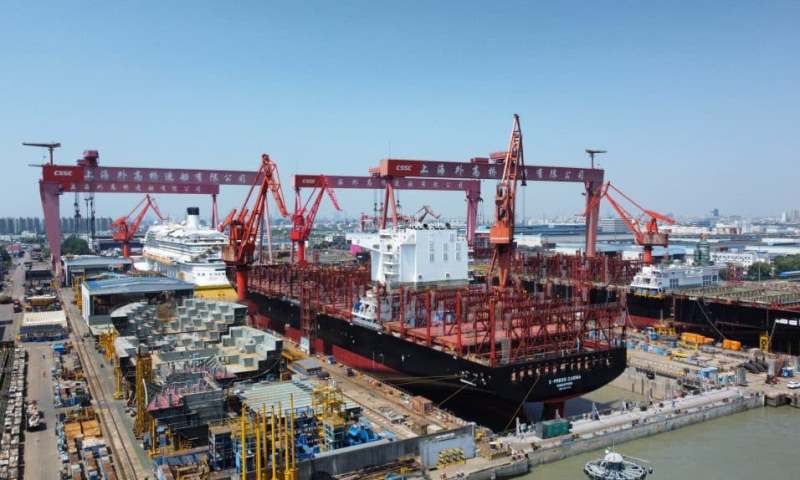
Currently, the shipbuilding industry is dominated by China, which produces over 60% of the world’s ships, followed by Japan and South Korea. Together, these three Asian countries build 85% of the world’s fleet.
India’s situation is improving gradually at the moment, Ramachandran said, adding that the country accounts for less than 1% of the world’s shipbuilding production.
For boosting indigenous shipbuilding, the government introduced New Shipbuilding Financial Assistance (SFA) policy in 2017, providing equal to 20% assistance to Indian shipyards of the either contract price, fair price or actual payments received of each vessel built by them for a period of at least 10 years.
Policy directives for promoting the adoption of Indian flagged vessels for government or PSU use have also been put in place, according to the ministry’s annual report.
The government also provisioned ₹25,000 crore in the budget in January, 2025 under the Maritime Development Fund. These funds in the short term will provide equity support to Indian players for increasing ownership of ships in India, aka Indian flagged ships. In the long term, the fund will be used for boosting shipbuilding in the country, according to Ramachandran.
Moreover, the government is preparing to expand existing shipbuilding capacity and commence 2-3 new greenfield shipyard facilities to achieve its goals for the maritime sector, according to Ramachandran.
Besides, Sagarmala Development Company, an entity under the ministry’s control, has also applied for Non-Banking Financial Company license to disburse funds for shipbuilding, ship repair and other projects.
SDC is likely to act as a catalyst to finance maritime development projects as it will tie up with PSU-lending agencies to fund large projects, an Elara Capital report said. The key beneficiaries are likely to include Shipping Corporation of India, Adani Ports & SEZ, JSW Infrastructure, Cochin Shipyard, ITD Cementation, and Afcons Infrastructure, according to the brokerage firm.
Indian shipbuilding sector is largely dominated by public sector companies like Cochin Shipyard, Mazagon Dock Shipbuilders, and others. There are 53 Shipyards in the country, 7 under the central public sector, 2 under state governments and 44 under private sector. Of these companies, there are only a handful of players whose shares are traded on the securities market.