
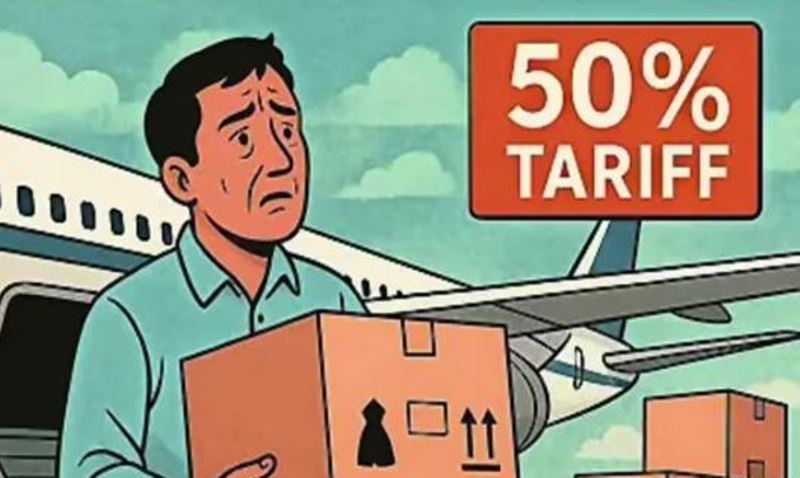
The Union government is preparing a comprehensive support package for Indian exporters reeling from a steep 50% tariff imposed by the United States, with the Union Cabinet expected to discuss the proposal on Wednesday, according to Business Standard.
Officials indicated that the package could comprise up to four schemes, primarily focused on credit and liquidity support, aimed at easing the impact on small and medium enterprises (MSMEs). Sectors such as textiles, apparel, gems and jewellery, leather and footwear, engineering goods, and agri-marine exports are expected to benefit the most.
“The Cabinet may take up the proposal on Wednesday. It will be in line with the credit guarantee schemes announced during the Covid period, especially for MSMEs,” an official said on condition of anonymity.
The measures aim to alleviate working capital stress, protect jobs, and provide exporters with time to explore alternative markets.
Economic Resilience Highlighted
Prime Minister Narendra Modi, speaking at the Semicon India 2025 conference on Tuesday, underscored India’s economic resilience amid global challenges. GDP grew 7.8% in Q1 FY26, surpassing expectations. While acknowledging “challenges driven by economic self-interest,” Modi emphasized that growth had outperformed all forecasts—a pointed response to former US President Donald Trump, who had previously described India as a “dead economy.”
Mirroring Covid-Era Relief
The planned measures echo the Covid-era Atmanirbhar Bharat package of May 2020, which included the ₹3 trillion Emergency Credit Line Guarantee Scheme (ECLGS) for MSMEs, along with subordinate debt schemes and a Fund of Funds to support growth-oriented businesses.
Officials say the new package may adopt a similar approach, stabilising export orders and helping firms utilise idle capacity. One potential initiative is the Export Promotion Mission (EPM), announced in the FY26 Budget, which is under appraisal by the Expenditure Finance Committee.
“The finance ministry is yet to approve the EPM and has raised queries on some proposed schemes. Final Cabinet approval is awaited, after which rules will be formulated and schemes implemented,” an official added.
Sectors Most Exposed
The US is India’s single largest export market, accounting for 18–20% of merchandise exports. Certain sub-sectors are heavily exposed: 60% of carpets, 50% of finished textiles, 30% of gems and jewellery, and 40% of apparel exports go to the US. The Global Trade Research Initiative estimates that 66% of Indian exports to America, worth $86.5 billion, could face higher duties—impacting roughly $60.2 billion in goods.
Government Response
Commerce and Industry Minister Piyush Goyal is scheduled to meet exporters on Wednesday to discuss sector-specific concerns. Proposed schemes under consideration include interest subvention for trade finance, factoring facilities, e-commerce export cards, and collateral support. Non-financial support under the EPM may include compliance guidance, branding and packaging assistance, logistics, and warehousing.
Despite delays in finalising the initiatives, officials stress that the broader objective is clear: to protect small exporters and labour-intensive industries, preserve employment, and maintain India’s global trade competitiveness amid rising tariffs.