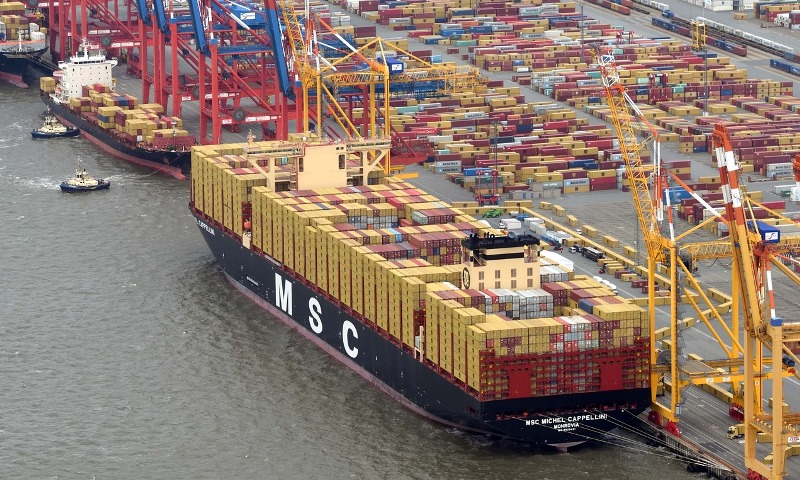
Mediterranean Shipping Company (MSC)’s deployment of 13,000–15,000+ TEU vessels is transforming the MED–NA East Coast trade lane, creating a two-tier fleet and intensifying pressure on US terminals.
In issue 741 of Sea-Intelligence Sunday Spotlight, the examined vessel capacity deployed on the Mediterranean to North America East Coast (MED-NAEC) trade lane.
Analysis of the second half of 2025 shows a sharp divergence between average and median vessel sizes, indicating that the increase in average vessel size is driven by a small number of larger vessels, rather than a broad structural shift across the fleet.
To illustrate this, Sea-Intelligence plotted every vessel deployed on the trade lane since 2012. This approach highlights the difference between the standard fleet evolution and specific outliers that are reshaping the market.
In 2025, however, a distinct second cluster appears in the 13,000–15,000+ TEU range. Two of these (shown in blue) are deployed by MSC on the EMUSA service but remain outliers, as the service continues to operate 8,000–9,000 TEU vessels.
This has created a two-tiered vessel size structure, with significant operational implications: North American East Coast terminals now face concentrated operational stress from these larger vessels, which require much higher container handling per call than the trade’s standard vessels.
Recently, Sea-Intelligence analysed the laden import volume throughput of the major North America West Coast (NAWC) ports through the first three quarters of 2025 in issue 740 of the Sea-Intelligence Sunday Spotlight.
