
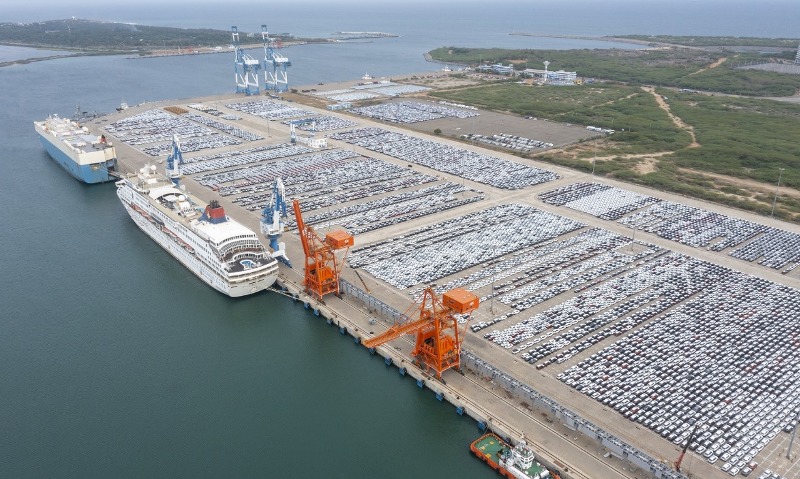
As Sri Lanka grapples with one of the worst flood disasters in its history—severely disrupting national infrastructure and suspending operations at the Port of Colombo—Hambantota International Port (HIP) has emerged as a crucial lifeline, remaining fully operational throughout the crisis.
Despite experiencing heavy rainfall, Hambantota remained outside the storm’s direct impact zone, allowing round-the-clock port activity. “While the bad weather did affect Hambantota to an extent, conditions here were far better than in Colombo and along the western coastline,” said Bindu Ranasinghe, Deputy General Manager – Commercial & Marketing at Hambantota International Port Group (HIPG). “Our teams demonstrated exceptional resilience across operations, navigation, marine services, security, and outsourced personnel. Thanks to their commitment, HIP continued operating 24/7 without suspension.”
The severe disruptions along the western coast underscored the national need for a second fully functional international port capable of handling all types of cargo. Ranasinghe stressed that HIP’s ability to continue processing container, RORO, bulk, and oil & gas shipments during adverse conditions reaffirmed its value as an essential national asset.
This strategic importance was further highlighted when an LPG carrier, unable to discharge in Colombo due to rough seas, was diverted to Hambantota. Acting on instructions from the Ministry of Finance and the Commissioner of Essential Services, and coordinated through the Sri Lanka Ports Authority, HIP facilitated the safe arrival and discharge of the LPG vessel PGC PATRES for LAUGFS. Ranasinghe noted that the port is fully equipped to handle such vessels efficiently, ensuring continuity in essential supply chains during emergencies.
Operational activities across HIP continued seamlessly despite intermittent heavy rains. Container and RORO handling proceeded with precautionary measures to prevent cargo exposure. Bulk cargo operations—typically halted during rainy conditions at most ports—remained unaffected, thanks to HIP’s enclosed warehouse systems that offer full protection and prevent contamination. Navigation teams also maintained on-time berthing and departure of vessels, ensuring uninterrupted maritime traffic flow.
The port’s resilience comes during what is poised to be a record-setting year for HIP. RORO throughput, container handling, bulk cargo volumes, and total TEU movement are all on track for all-time highs, with TEU volumes already surpassing eight times last year’s figures. Wilson Qu, CEO of HIPG, confirmed that 2025 is shaping up to be one of the port’s strongest years, driven by the teams’ ability to efficiently manage unexpected surges in cargo volumes.
As the nation confronts one of its most challenging weather-related crises, the Hambantota International Port has demonstrated its critical role as a dependable, all-weather maritime hub—safeguarding Sri Lanka’s supply chains and supporting national resilience.