
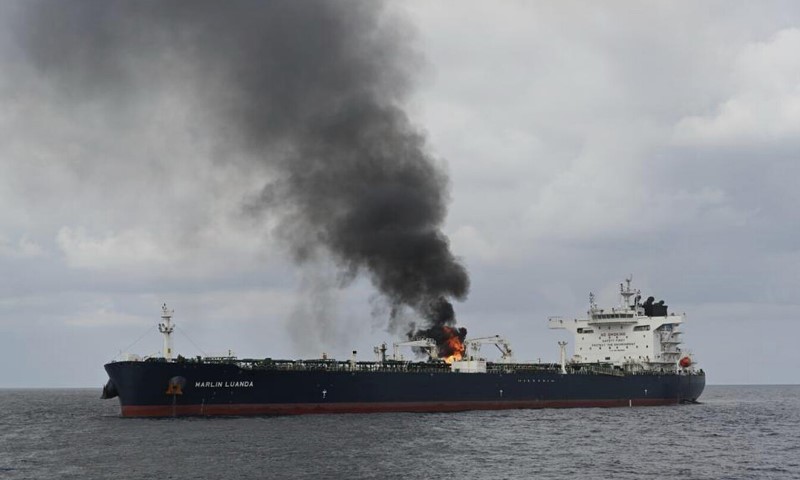
An oil tanker was attacked off the coast of Oman in the strategic Strait of Hormuz, injuring four crew members and forcing a full evacuation, as geopolitical tensions intensify following US–Israel strikes on Iran.
Oman’s Maritime Security Centre confirmed that the Palau-flagged tanker Skylight was targeted about five nautical miles north of Khasab Port in the Musandam Governorate. All 20 crew members — comprising 15 Indian nationals and five Iranian nationals — were safely evacuated. Preliminary reports indicate that at least four sustained injuries and were transferred for medical treatment, according to Gulf News.
Omani authorities also reported that the Port of Duqm was targeted in a separate drone attack, underscoring the growing security concerns across the Sultanate’s maritime domain.
Strait Effectively Closed After IRGC Warning
The incident came a day after Iran’s Islamic Revolutionary Guard Corps (IRGC) reportedly declared via radio transmissions that the Strait of Hormuz was closed to international navigation. While Tehran has not formally announced a blockade, multiple vessels in the area received VHF warnings stating that “no ship is allowed to pass the Strait of Hormuz,” Reuters reported.
The British Navy clarified that such warnings are not legally binding but urged vessels to exercise extreme caution. An EU naval mission official indicated that disruptions were escalating rapidly, though traffic had not come to a complete halt.
The Strait of Hormuz — connecting the Persian Gulf to the Gulf of Oman — handles roughly 20% of global oil supply along with significant LNG exports, particularly from Qatar. It remains one of the world’s most critical maritime choke points.
Ships Halted, Insurers Withdraw Cover
Several tanker owners and oil majors have reportedly suspended crude and LNG shipments through the route. Satellite imagery showed vessels queuing near Fujairah in the UAE.
German shipping giant Hapag-Lloyd announced it was suspending transits through Hormuz, while French carrier CMA CGM instructed vessels to seek safe shelter. Energy consultancy Kpler noted that at least 14 LNG tankers had slowed, stopped, or reversed course. Among them, the KHK Empress and India-flagged Desh Abhimaan reportedly turned back, according to Euronews.
Marine insurers have also withdrawn coverage for voyages through the area, exposing operators to significant war-risk premiums and operational uncertainty.
Regional Ripple Effects
The disruption has spilled over into neighbouring countries. According to ANI, three Pakistan National Shipping Corporation vessels — Karachi, Lahore, and Khairpur — were prevented from entering Hormuz by Iranian authorities. Two were held at Fujairah port in the UAE, while one anchored at Gwadar in Pakistan.
The escalation follows joint US–Israeli strikes that reportedly killed Iranian Supreme Leader Ayatollah Ali Khamenei, triggering missile retaliation across the region.
Oil markets reopened Sunday evening amid speculation that Brent crude could surge toward $100 per barrel, levels last seen after Russia’s 2022 invasion of Ukraine. Barclays analysts warned that a prolonged disruption in Hormuz could block up to 20 million barrels per day — nearly one-fifth of global supply.
With vessel traffic stalled, insurance cover withdrawn, and geopolitical tensions mounting, the situation in the Strait of Hormuz remains highly volatile. Any further escalation could have profound consequences for global energy markets and maritime trade.