
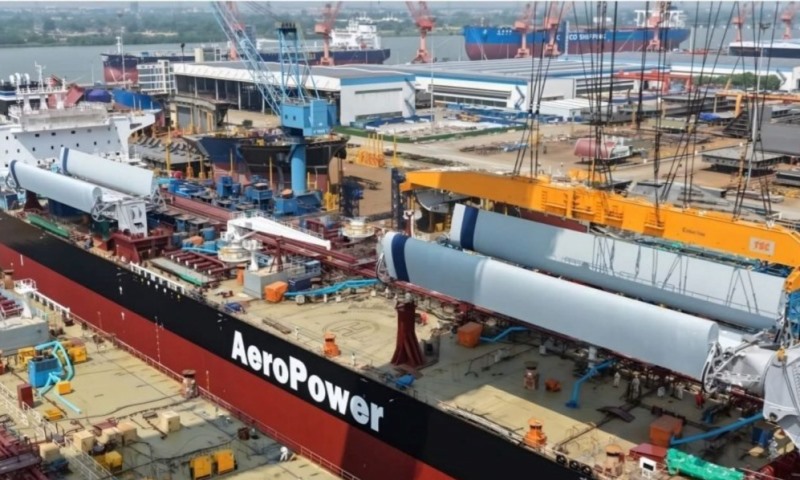
COSCO Shipping Heavy Industry has successfully completed the installation of three giant wind wings on a 114,000 DWT product tanker at its Yangzhou shipyard, marking the company’s first newbuild vessel equipped with wind-assisted propulsion technology.
The milestone represents a significant step in the adoption of low-emission technologies in commercial shipping, as shipowners and shipbuilders accelerate efforts to improve fuel efficiency and reduce carbon emissions.
The vessel has been fitted with three large wind wings designed to generate auxiliary thrust by utilizing pressure differences across the sail surfaces. The technology helps reduce reliance on the ship’s main engine, thereby lowering fuel consumption and greenhouse gas emissions during normal operations at sea.
Each wind wing measures approximately 48 metres in height and 20 metres in width, with an individual weight of around 200 tonnes. According to project estimates, a single wing can save nearly 1.5 tonnes of fuel per day while reducing carbon dioxide emissions by about 4.7 tonnes daily. With all three units operating simultaneously, the tanker is expected to achieve substantial savings in fuel use and emissions.
The installation is regarded as one of the more advanced procedures in modern shipbuilding, particularly as China’s newbuild sector continues to develop standards for wind-assisted propulsion integration. Since initiating feasibility studies in 2023, the Yangzhou shipyard formulated 26 standardized operating procedures along with four dedicated inspection checklists to support the project.
For the installation process, the shipyard deployed a 900-tonne gantry crane to carry out precision lifting operations. Engineers also utilized advanced 3D laser tracking technology to maintain boring deviations within 0.03 millimetres, enabling micron-level assembly accuracy.
The shipyard stated that the engineering methods and installation procedures developed during the project have now been standardized and can be replicated for future wind-assisted vessel construction programs, supporting broader industry adoption of sustainable propulsion solutions.