
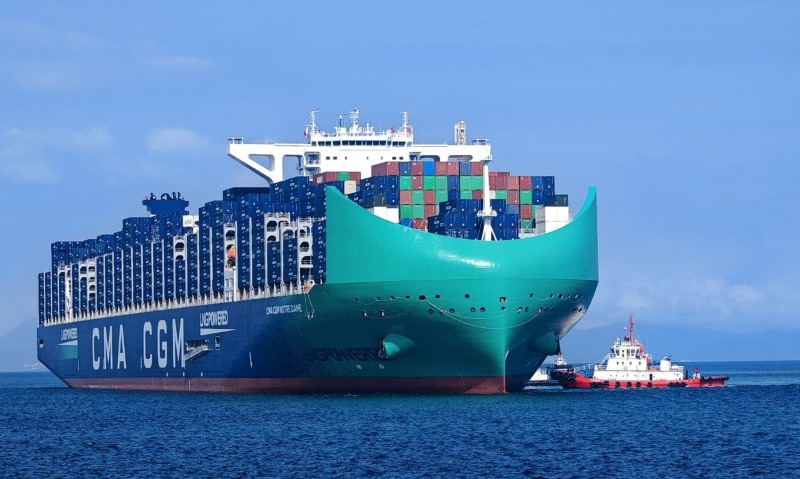
French shipping giant CMA CGM is on track to surpass A.P. Moller – Maersk as the world’s second-largest container shipping line by fleet capacity, with industry analysts expecting the milestone to be reached by mid-2027.
Speaking to French business daily Les Echos, CMA CGM Chairman and Chief Executive Rodolphe Saadé said the Marseille-based carrier is expected to move ahead of its Danish rival within the next 18 months.
According to industry analyst Linerlytica, the transition could occur as early as July 2027. Current fleet rankings from Alphaliner place Mediterranean Shipping Company (MSC) firmly in first place with approximately 7.3 million TEUs of capacity, followed by Maersk at around 4.7 million TEUs and CMA CGM with about 4.4 million TEUs. The French carrier’s substantial orderbook is expected to close the remaining gap.
The shift reflects contrasting strategic priorities among the industry’s leading carriers. While Maersk has focused on transforming itself into an integrated logistics provider with a disciplined fleet expansion strategy, CMA CGM has aggressively increased vessel capacity while investing across terminals, logistics, air cargo and inland transportation.
Hua Joo Tan, founder of Linerlytica, noted that Maersk’s expected decline in ranking stems from its deliberate emphasis on logistics integration rather than fleet expansion, allowing competitors to capitalize on stronger earnings in the ocean shipping business.
Industry observers believe the ranking change carries symbolic significance beyond capacity figures. Maersk long served as the benchmark for the global container shipping industry, but MSC has already established a commanding lead, while CMA CGM has leveraged strong pandemic-era profits to build a diversified global transport and logistics group.
Alan Murphy, Chief Executive of Sea-Intelligence, said Maersk appears willing to sacrifice its second-place ranking, suggesting the company believes maintaining fleet size offers fewer benefits than pursuing its long-term integrated logistics strategy.
Analysts also caution that Maersk could eventually slip further in the rankings, with China’s COSCO Shipping positioned to challenge for third place over the longer term.
Despite its expected rise, CMA CGM’s expansion comes as the container shipping industry enters another major vessel delivery cycle. Experts warn that increasing global capacity could pressure freight rates and profitability, making financial discipline and operational efficiency as important as fleet size in the years ahead.