
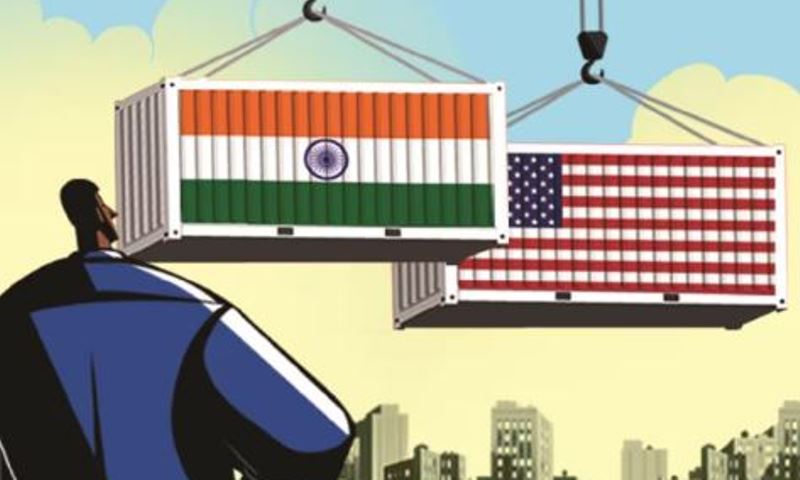
India’s exports to the United States have remained relatively resilient despite the tariff measures introduced under President Donald Trump, but the country’s bilateral trade surplus with the US narrowed sharply in FY2025-26, according to a report citing Bloomberg data.
The resilience of Indian exports is notable given the higher tariff environment and growing uncertainty surrounding global trade. The US continues to be India’s largest export destination, with its share of India’s merchandise exports remaining close to 20%, indicating that American demand for Indian products has not declined significantly.
However, the trade balance has changed as India’s imports from the US increased faster than exports, reducing the surplus that India traditionally maintains in bilateral goods trade. The shift suggests that while tariff pressures have affected the trading relationship, they have not yet triggered a major reduction in Indian shipments to the US.
India’s overall export performance has also remained strong. Merchandise exports reached a record $44.24 billion in July 2026, up about 19% from a year earlier, despite geopolitical uncertainty, elevated freight costs and shipping disruptions.
The US market continues to be particularly important for several Indian export sectors, including engineering goods, pharmaceuticals, textiles, electronics, gems and jewellery and other manufactured products. The ability of exporters to maintain shipments despite tariff uncertainty reflects both established supply-chain relationships and continued demand for Indian products.
At the same time, higher imports from the US are contributing to a broader change in the bilateral trade equation. Increased purchases of energy products, machinery, technology and other goods can narrow India’s trade surplus even when exports remain relatively stable.
India is also pursuing greater market diversification to reduce excessive dependence on individual markets. However, the US remains a critical destination, and recent trade data indicates that diversification efforts have yet to significantly reduce its share of India’s exports.
For exporters and logistics companies, the continued strength of India-US trade is significant. However, higher tariffs, changing trade policies, freight costs and regulatory uncertainty remain key factors that businesses must consider when planning shipments and investment.
The latest trend therefore presents a mixed picture: Indian exports to the US are holding up despite tariff pressures, but the shrinking trade surplus indicates that the structure of bilateral trade is changing. The outcome of ongoing India-US trade negotiations could play an important role in determining the future trajectory of this major trade corridor.