
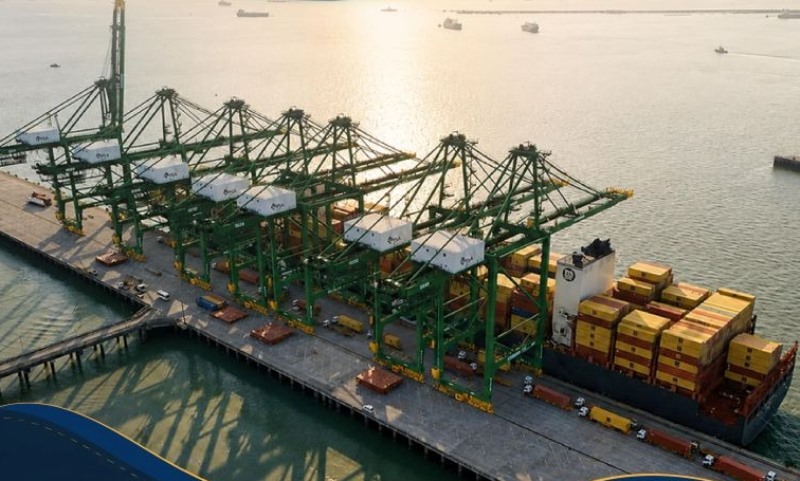
A long-running dispute between VOC Port Authority and PSA SICAL Terminals Ltd over unpaid royalty exceeding ₹2,057 crore, including interest and penalty, has been referred to the Conciliation and Settlement Committee (CSC) for a possible resolution.
The CSC, headed by former Ports, Shipping and Waterways Secretary Gopal Krishna, will attempt to broker a settlement in one of India’s most litigated port PPP projects. PSA SICAL, in which Singapore’s Temasek-backed PSA International holds a 51% stake, operated the container terminal at VOC Port under a 30-year agreement signed in 1998.
The dispute centres on royalty payments that were frozen at ₹1,969 per TEU, the contractual rate applicable in 2011, following a Thoothukudi district court order obtained by PSA SICAL. The company had argued that repeated tariff reductions imposed by the then port tariff regulator made the terminal commercially unviable as royalty obligations continued to escalate.
Under the original agreement, royalty was linked to either actual cargo handled or a minimum guaranteed throughput of 3 lakh TEUs, with the royalty rate scheduled to rise by 20% annually. By 2028, the contractual royalty was to reach ₹5,178 per TEU.
The royalty dispute reached the Supreme Court, which in July 2021 rejected PSA SICAL’s claim for conversion from the royalty model to a revenue-sharing model and held that there was no applicable “change in law” when the agreement was signed.
Following the verdict, VOC Port Authority raised royalty demands. Dues for the period July 2011 to February 2019 were initially assessed at ₹1,027.37 crore, rising to ₹1,406.10 crore by December 2021 after interest and other charges.
A separate arbitration over the depth available at PSA SICAL’s berth further complicated the dispute. PSA SICAL alleged that its berth was disadvantaged by the deeper draft available at an adjacent terminal. Under an interim arbitration arrangement, the company paid ₹1.5 crore per month from March 2019 to October 2023 instead of the contractual royalty, before stopping payments altogether.
The port authority subsequently issued termination notices. However, the Supreme Court ordered maintenance of status quo on the termination in June 2022, and the matter remains pending along with the arbitration proceedings.
PSA SICAL eventually shut operations and exited the terminal on February 28, 2025, after which VOC Port Authority took over the berth. The port authority estimates the outstanding royalty, including interest and penalty, at more than ₹2,057 crore.
The referral to the CSC comes while key issues concerning the legality of the royalty demand and termination order remain sub judice. Any settlement proposed by the committee would require acceptance by both parties.
The dispute is particularly significant as both sides are ultimately linked to government-owned entities—VOC Port Authority in India and PSA International, a unit of Singapore’s sovereign wealth fund Temasek.
The terminal project was awarded to PSA SICAL in 1998 after it quoted a ₹139 crore net present value, substantially higher than the next bidder. PSA SICAL invested around ₹95 crore to develop the terminal, which began operations in December 1999 with a capacity of about 4.5 lakh TEUs.
While port officials maintain that the contractual royalty is legitimately due and critical for funding future infrastructure projects, including the proposed Outer Harbour, industry sources argue that PSA SICAL’s high initial royalty bid and subsequent tariff changes contributed to the terminal’s financial difficulties.
The CSC-led settlement process will now attempt to resolve a dispute that has remained before courts and arbitral forums for more than a decade, with billions of rupees in royalty claims at stake.