
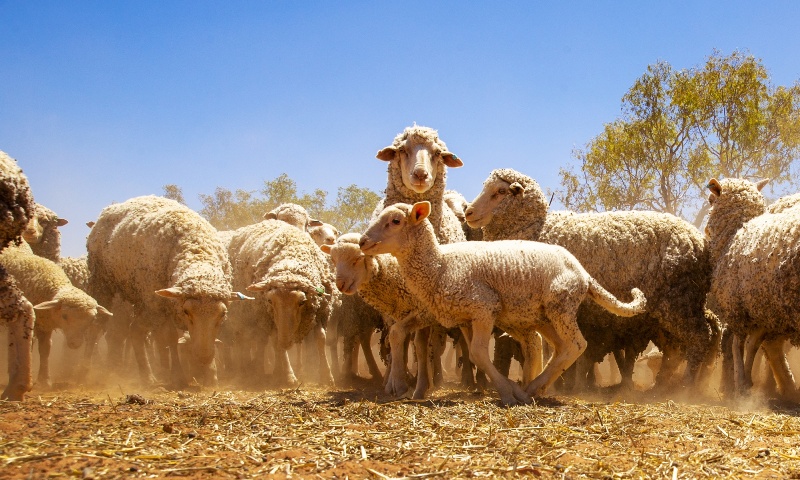
The Australian government is eyeing a burgeoning sheep meat trade with the United Kingdom, United States and China as it prepares to phase out live export of the animals to the Middle East.
A timeline on the closure of the live sheep export industry is expected to be handed down this year, stoking major concern among West Australian farmers, who have relied on sales to the Middle East for decades.
Dry conditions and low prices for sheep meat have exacerbated anxiety within the WA farming community ahead of the looming ban, but federal Agriculture Minister Murray Watt said international demand for meat processed in Australia and shipped internationally was increasing.
The federal government is predicting sheep meat exports to increase from 500,000 tonnes in 2022-23 to 562,000 tonnes next financial year, with India, the US and UK among emerging markets.
“We are seeing incredible growth in new and existing markets, with new trade deals in the UK and India opening up even more destinations for our delicious Aussie lamb and mutton,” Mr Watt said.
“A lot of this is off the back of the Western Australian sheep industry, which remains strong despite challenging dry conditions and lower prices.”
Government data shows sheep meat exports from WA to the UK doubled in 2022-23, while lamb exports from WA and NSW to China were their highest on record, having increased from 14,000 tons in 2013-24 to 57,000 in 2022-23.
Mr Watt pointed to Australia’s free trade deal with the UK as a major factor in the increase.
“More sheep being processed here means more jobs here and that is a good thing for Australia,” he said.
However, Australian Livestock Exporters Council chief executive Mark Harvey-Sutton said banning the live sheep trade could prompt many WA farmers to exit the industry altogether, rather than look to process their animals locally.
“By having this policy in place, all the federal government has done is shot the confidence of the entire sector because they have put a shadow over a very important market,” he said.
“What I fear is that there will actually be less sheep production as a result of this policy. If people do not have a range of markets, then I think the risk is the WA sheep industry could be irreparably damaged.”
Mr Harvey-Sutton also warned the Australian government against attempting to dictate to a market what products it could access.
“Market dynamics don’t work when you go ‘We’re going to produce a certain product, and then the customer just has to accept that’ – that’s not how it works,” he said.
While the government eyes new trade partners for Australian sheep meat, Kuwait warned last year it would not buy any more chilled meat from Australia after the live export ban, and would instead source livestock from other countries.
The Middle Eastern market for processed, chilled meat has been inconsistent, with solid increases in Jordan and Bahrain between 2021 and 2023, while exports to Qatar and Saudi Arabia have slipped.