
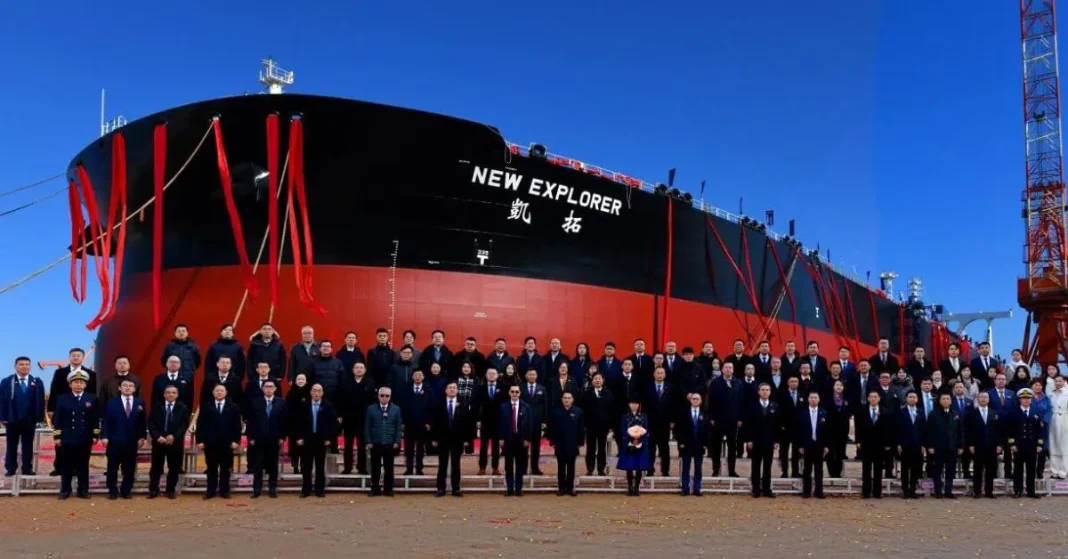
China has delivered the world’s first methanol dual-fuel very large crude carrier (VLCC), New Explorer, marking a major milestone in the decarbonisation of deep-sea oil transport. The vessel was officially handed over on 22 December in Dalian and has now entered commercial service.
The ship was built by Dalian Shipbuilding Industry Company (DSIC), a subsidiary of China State Shipbuilding Corporation (CSSC), for China Merchants Shipping. It is classed by China Classification Society (CCS), which played a key role in supporting the project and facilitating its early delivery.
New Explorer is an eighth-generation VLCC independently developed by DSIC. Measuring about 333 metres in length, the tanker has a cargo capacity of approximately 2.1 million barrels of crude oil. It features a shallower full-load draught than conventional VLCCs, enabling easier transit through the Malacca Strait and access to a wider range of ports.
Designed with a strong focus on seaworthiness, low emissions and intelligent operations, the vessel is powered by a domestically produced methanol dual-fuel main engine, supported by a dedicated methanol fuel supply system. Compared with conventional fossil-fuel-powered tankers, New Explorer can reduce carbon dioxide emissions by up to 92 per cent, sulphur oxide emissions by 99 per cent and particulate matter by 90 per cent.
The VLCC is also equipped with advanced onboard intelligent platforms to support modern ship operations. These include an intelligent liquid cargo control system and an intelligent engine room operation and maintenance system, aimed at enhancing operational efficiency, economic performance and safety.
The intelligent liquid cargo control system integrates more than ten subsystems covering crude oil loading, unloading and transportation. It enables coordinated multi-system control, supports intelligent cargo operations and provides decision-making assistance based on expert knowledge.
CCS said it was closely involved throughout the research, design, construction and commissioning phases of the project, providing technical support in green technologies and intelligent ship solutions. The classification society noted that its involvement contributed significantly to the successful delivery of New Explorer and its smooth entry into commercial service.
The delivery of New Explorer underscores China’s growing capabilities in developing next-generation, low-emission large vessels and represents a significant step forward in the global shipping industry’s transition towards cleaner fuels.