
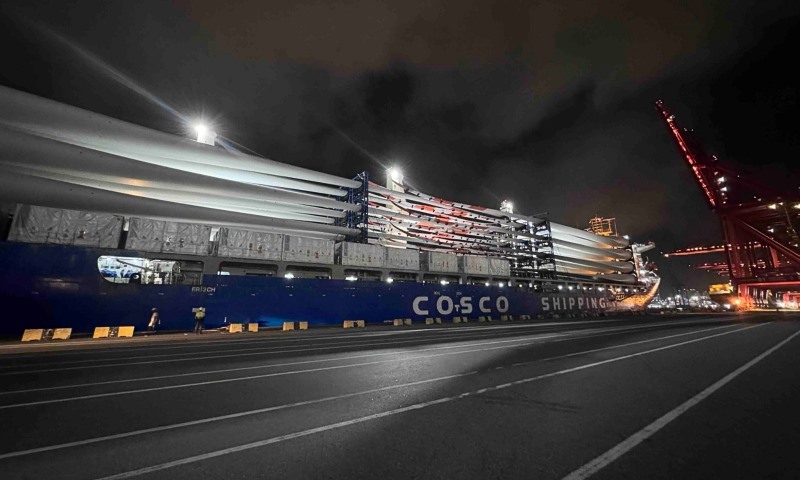
Colombo International Container Terminals (CICT) has successfully handled a 2,241-tonne Battery Energy Storage System (BESS) shipment comprising 54 battery units destined for Sri Lanka’s largest energy storage programme to date, reinforcing the country’s efforts to strengthen grid stability, accelerate renewable energy integration, and enhance long-term energy security.
The shipment arrived aboard Da Xiang, a specialised heavy-lift vessel operated by COSCO Shipping. Each battery unit, equivalent in size to a standard 20-foot container, weighed approximately 41.5 tonnes, necessitating meticulous planning, specialised equipment deployment, and stringent safety measures throughout the discharge and storage operations.
The BESS units are part of a nationwide deployment across 16 substations and represent Sri Lanka’s most extensive energy storage initiative. The project is expected to play a pivotal role in helping the country achieve its target of generating 70 per cent of its electricity from renewable sources by 2030. It will also improve grid flexibility, strengthen energy security, and reduce dependence on imported fossil fuels.
Recognising the strategic importance and specialised handling requirements of the cargo, CICT developed a dedicated operational plan ahead of the vessel’s arrival. The discharge operation was conducted during a specially scheduled midnight shift, with two quay cranes, 16 prime movers, and two reach stackers deployed exclusively for moving the battery units from the vessel to the storage yard.
As part of its contingency planning, the terminal also positioned two Rubber Tyred Gantries (RTGs) on standby with modified lifting configurations. While the terminal’s RTGs are typically rated to handle loads of up to 40.5 tonnes, each BESS unit exceeded that threshold. Technical adjustments were completed in advance to provide additional lifting capability if required. Although the standby RTGs were ultimately not utilised, the preparations formed a key element of CICT’s comprehensive risk management strategy.
The operation was carried out by a specially selected team comprising two quay crane operators, 16 prime mover drivers, two reach stacker operators, and two RTG operators. Personnel were chosen based on their extensive operational experience and strong safety records to ensure the cargo was handled under enhanced safety protocols.
Commenting on the achievement, CICT Chief Executive Officer Jan Zhang said the successful handling of the shipment demonstrated the terminal’s capability to manage highly specialised project cargo requiring meticulous planning, technical expertise, and uncompromising safety standards.
“As Sri Lanka accelerates investments in renewable energy and grid modernisation, ports will play a critical role in enabling the timely delivery of strategic infrastructure. We are proud to contribute to a project that supports the country’s energy security, sustainability goals, and long-term economic development,” Zhang said.
Given the specialised nature of the cargo, CICT implemented dedicated yard management arrangements for safe storage and onward distribution. Unlike conventional container operations, the battery units were not stacked. Instead, each of the 54 units was allocated an individual ground slot within the terminal yard.
Under normal conditions, a single yard slot can accommodate stacks of up to six containers. However, CICT reserved 54 dedicated slots for the shipment, highlighting the exceptional planning and space allocation required for the project. The arrangement also enabled direct retrieval for delivery, eliminating unnecessary sorting, shifting, and additional cargo movements.
To facilitate efficient inland transportation, the terminal segregated the battery units according to their final delivery destinations, creating dedicated storage zones that minimised handling and supported seamless movement from the port to project locations across Sri Lanka.