
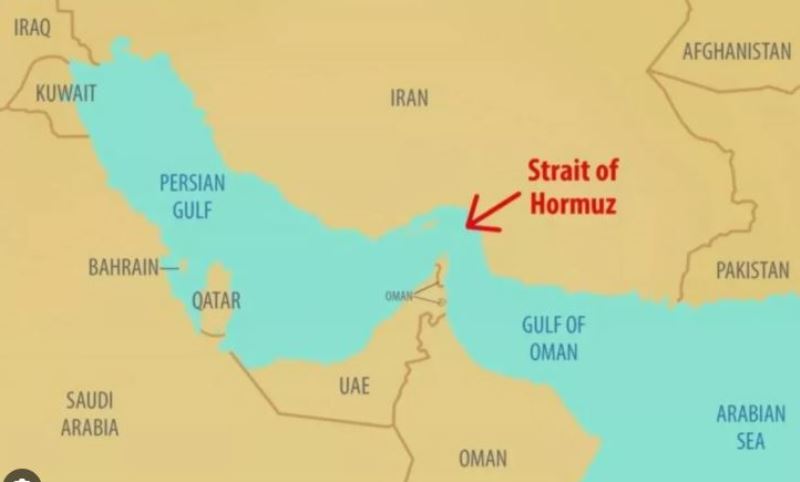
The war involving Iran has effectively halted oil tanker movement through the strategic Strait of Hormuz, triggering widespread disruption across global supply chains that extend far beyond crude oil.
Shipping data from Clarksons Research estimates that around 3,200 vessels — roughly 4% of global ship tonnage — are currently idle inside the Persian Gulf, including 1,231 ships that primarily operate within the Gulf region. An additional 500 ships, or about 1% of global tonnage, are waiting outside the Gulf at ports off the coast of the United Arab Emirates and Oman.
The disruption is not limited to maritime transport. Cargo ships are either stranded in Gulf waters or taking longer detours around the southern tip of Africa. Air cargo movements have also been severely constrained, with closed airspace and airport shutdowns across the UAE, Qatar, Bahrain, Kuwait, Iraq and Iran grounding aircraft and stranding both passengers and freight.
Ripple Effects Across Industries
About 20% of the world’s oil flows through the region, but the crisis is now impacting a much wider range of goods. Petrochemical feedstock derived from natural gas, nitrogen fertilisers, pharmaceuticals exported from India, and semiconductors and batteries shipped from Asia are all facing delays.
Patrick Penfield, professor of supply chain practice at Syracuse University, warned of escalating consequences.
“This is really causing some major impacts within the global supply chain,” he said, adding that prolonged conflict could lead to shortages and significant price increases. He compared the global supply chain to a long train, where disruption at one port can create a domino effect worldwide.
Instability has also dampened transit through the Red Sea and the Suez Canal, just as traffic had begun recovering following earlier Houthi attacks on shipping.
US Moves to Stabilise Shipping
On March 3, 2026, US President Donald Trump proposed measures to restore oil and trade flows through the Strait. He said he had directed the U.S. International Development Finance Corporation to provide political risk insurance to tankers transiting the Persian Gulf at what he described as a “very reasonable price.” He also indicated that the US Navy could escort oil tankers through the Strait of Hormuz if necessary.
Political risk insurance covers financial losses arising from unstable political conditions, government actions or conflict. Marine insurers have recently cancelled coverage or sharply increased premiums for vessels operating in the region.
Air Cargo Under Pressure
Air freight is also facing mounting strain. The region’s major carriers — Emirates, Qatar Airways and Etihad Airways — operate dedicated cargo fleets and carry freight in passenger aircraft belly holds. Airport closures across the Gulf have significantly reduced available capacity.
Although air freight accounts for less than 1% of global cargo by volume, it represents about 35% of global trade value, according to Boeing’s World Air Cargo Forecast. High-value and time-sensitive goods such as pharmaceuticals, electronics and perishable produce are particularly vulnerable to delays.
Maersk said in an operational update on March 3 that it expects air freight rates to rise due to reduced capacity, increased demand and additional surcharges.
Industry Adapts Amid Uncertainty
Henry Harteveldt of Atmosphere Research Group noted that travel and cargo routes to India have become increasingly difficult. However, industry leaders say the logistics sector has grown more resilient after years of disruption, including the COVID-19 pandemic and earlier regional conflicts.
Michael Goldman, general manager for North America at CARU Containers, described the current crisis as unprecedented but said the industry has become accustomed to operating under disruption.
“For the last few years the industry just kind of runs on disruption,” he said. “In terms of our industry having disruption, that is nothing new.”
As the conflict drags on, however, the longer-term risks of supply shortages, rising freight costs and inflationary pressures across multiple sectors continue to mount.