
India has emerged as major investment destination for Korean firms as the South Asian country with one of the biggest consumer markets in the world has continued to increase its trade volume with Korea year after year.
Bilateral trade in 2022 reached a record level of $27.8 billion. India’s import volume that year stood at $ 18.8 billion and export volume at $9 billion.
Four years ago, bilateral trade stood at $20 billion, with Korea exporting $15 billion. The total figure dipped the following year to $16.8 billion but rebounded to $24 billion in 2021 and increased further to the highest historical level the following year.
As of August this year, Korea exported to India $11.7 billion and imported over $4.4 billion from India.
Major items of India’s exports to Korea are mineral fuels and oil distillates, cereals, iron and steel. Korea’s main export items are car parts, telecommunications equipment, hot-rolled iron products, refined petroleum products, base lubricating oils, mechanical appliances, electrical machinery parts and iron and steel products.
Since India and Korea launched the “Korea Plus” initiative to promote Korean investments in India, Korea’s total foreign direct investment (FDI) to India as of December 2022 stood at $7.8 billion, according to the Export-Import Bank of Korea. Investment by India in Korea, meanwhile, reached approximately $5.2 billion, which was led by Tata Daewoo and Aditya Birla Group. Tata Motors acquired Korea’s Daewoo Commercial Vehicle Company for $102 million in 2004.
Korea’s car exports to India particularly shined this year as Hyundai Motor has sold over 450,000 vehicles, an 8.8 percent year-on-year jump. Kia sold almost 200,000, a year-on-year increase of 1.1 percent. The sales boon in India helped Hyundai Motor Group further cement its goal this year of securing a spot in the “Big 3” global carmakers.
Exchanges in financial sectors in recent years are also notable. In 2016, the State Bank of India opened a branch in Seoul to provide a wide range of services including loan services and project financing for Korean and Indian companies. Six Korean Banks have branches in India, including KEB Hana, Kookmin, Shinhan, Woori, Nong Hyup and IBK.
In total, there are more than 600 Korean firms operating in India, according to the Embassy of India in Seoul.
Other latest business ventures in India by Korean firms include a possible joint battery factory by LG Energy Solution, the launch of the affordable Galaxy Tab A9 tablet by Samsung Electronics and expansion of the Choco Pie production line in Lotte Wellfood’s factory in Chennai.
According to the India Embassy, bilateral trades took a strong leap in 2010 when the two countries signed the Comprehensive Economic Partnership Agreement (CEPA). The relationship developed further in 2015 when India’s Prime Minister Narendra Modi paid a state visit to Seoul and agreed to upgrade the bilateral relationship to a “special strategic partnership.” In 2018, when then-Korean President Moon Jae-in visited India, both countries issued a statement outlining “Vision for People, Prosperity, Peace and our Future.”
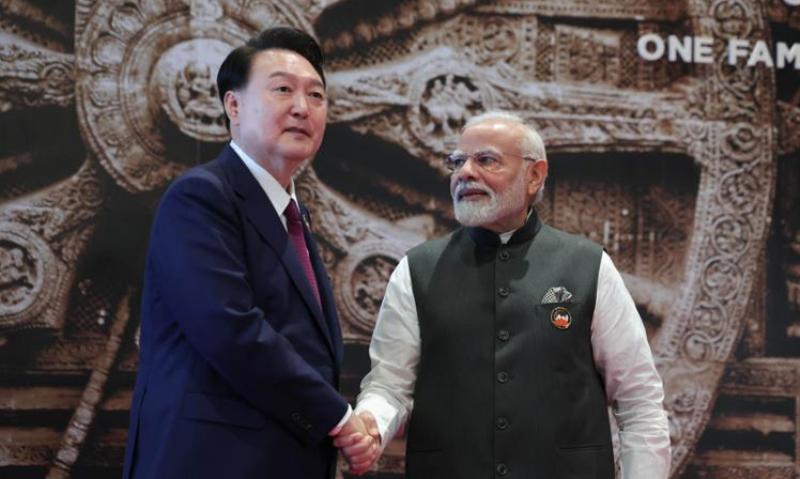
Modi’s relationship with Korea extended to incumbent President Yoon Suk Yeol, who visited India last month to attend the G20 Summit in New Delhi. On the sidelines of the summit, Modi and Yoon had a bilateral meeting.