
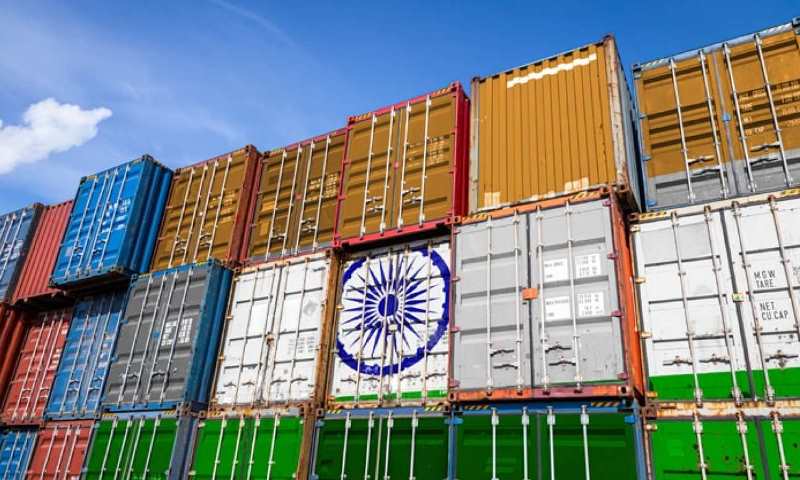
India has emerged as a stronger and more competitive player in global trade, with total exports reaching a historic high of US$863 billion in FY 2025-26, up from US$468 billion in FY 2014-15, according to the Department of Commerce. The achievement highlights over a decade of reforms, trade facilitation measures, and export promotion initiatives aimed at positioning India as a global export hub.
Driven by the vision of Prime Minister Narendra Modi to transform India into a “Global Export Hub,” the Department of Commerce has promoted the concepts of “Vocal for Local” and “Local to Global,” enabling Indian businesses and products to expand their footprint in international markets.
Over the last twelve years, India’s export growth has been supported by policy reforms, digital transformation, trade facilitation measures, and strategic trade agreements. Merchandise exports increased from US$310 billion to US$442 billion, while services exports surged from US$158 billion to over US$421 billion, registering a robust CAGR of 9.3 percent. Key export sectors driving this growth include engineering goods, electronics, pharmaceuticals, textiles, agricultural products, marine products, and gems and jewellery.
The Department also introduced a range of digital initiatives to improve ease of doing business and streamline trade processes. Platforms such as the Trade Connect Portal, Trade Intelligence and Analytics (TIA) Portal, Merchandise Imports Monitoring Portal (MIMP), online Importer Exporter Code (IEC) generation, and digital certification systems have enhanced transparency, reduced compliance burdens, and improved access to trade-related services.
India’s trade engagement with global partners has also expanded significantly through major agreements, including the India-UAE CEPA, India-Australia ECTA, India-UK FTA, India-EU FTA, India-Oman CEPA, and India-New Zealand FTA. These agreements have opened new markets, reduced tariffs, attracted investments, and strengthened India’s integration into global value chains.
A standout performer has been India’s marine products sector, which recorded seafood exports worth US$8.45 billion in 2025-26, the highest ever. Frozen shrimp continued to dominate the sector, accounting for more than 66 percent of total export earnings, while the United States and China remained the largest markets for Indian seafood exports.
Among the states, Odisha has emerged as a significant contributor to seafood exports. During 2025-26, the state exported 100,897 metric tonnes of seafood valued at US$623.28 million (₹5,428.67 crore), registering growth of 9.63 percent in volume and 11.90 percent in value compared with the previous year. Odisha’s seafood industry is supported by 64 registered exporters, 45 processing plants, modern cold storage facilities, and 36 shrimp hatcheries, with Vannamei shrimp production reaching 53,628 metric tonnes.
The state’s fisheries infrastructure includes major fishing harbours at Paradip Fishing Harbour, Dhamara Fishing Harbour, and Balaramgadi Fishing Harbour, along with key fish landing centres at Bahabalpur, Balugaon, Chudamani, and Kosia. Containerised seafood exports through Paradip Port more than doubled during the year, with container movements rising from 76 to 158 units.
Beyond seafood, Odisha is also emerging as a promising agricultural export hub, leveraging its diverse production base and unique GI-tagged products. The state has strong export potential in cashew nuts, groundnuts, sweet potatoes, mangoes, pineapples, dragon fruits, millets, spices, dairy products, floriculture products, and processed foods. The MITS Mega Food Park is expected to further boost value addition and export-oriented food processing activities.
The Department of Commerce has also strengthened export competitiveness through flagship initiatives such as the Foreign Trade Policy 2023, Districts as Export Hubs Programme, RoDTEP, RoSCTL, Trade Infrastructure for Export Scheme (TIES), and Niryat Bandhu capacity-building programmes. These measures have helped improve infrastructure, enhance exporter capabilities, and promote sustainable export growth across the country.
With exports continuing to expand and trade reforms gaining momentum, India is steadily advancing towards its long-term objective of becoming a leading global trading power and achieving the vision of Viksit Bharat 2047.