
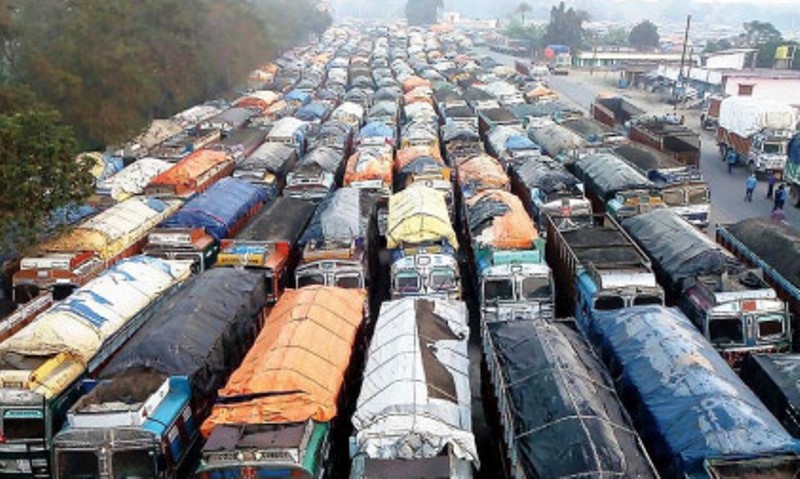
India is reportedly losing Rs 25 crore in revenue every day as trade with Bangladesh through the Mahdipur International Land Port in West Bengal has nearly halved.
As per exporters, earlier, at least 350-400 lorries loaded with Indian goods crossed the border every day. That number has now dropped to around 150-200, hitting exporters and importers on both sides. This sharp decline has been triggered by the political instability in Bangladesh and recent Indian government policies, including the imposition of GST on exports from August.
On Sunday, a crucial meeting was held by the Exporters Association in Mahdipur, which was attended by traders from both India and Bangladesh. The meeting decided to jointly write to the respective governments, urging immediate steps to restore trade through this border to previous levels.
Following the meeting, Bangladesh Importers Association President Ekramul Haque said, “At the moment, the relationship between the two countries is not very good. We have discussed to resolve this problem. We will try to increase businesses.”
“Less vehicles means loss to traders from both India and Bangladesh. We are working together to see how quickly the situation can be normalised. Indian exporters have also said that they will approach their government in this regard,” he added.
Prosenjit Ghosh, Secretary of the Mahdipur Exporters Association, explained that not only are fewer lorries being allowed through, but most goods except stone are barely crossing the border anymore. He said, “Discussions were held on how to further improve trade between the two countries, and send more lorries loaded with goods from India to Bangladesh. Earlier, 350-400 lorries loaded with goods used to go from India to Bangladesh daily. Now, not more than 150-200 lorries carry goods across the border. This is harming Indian as well as Bangladeshi exporters.”
“Currently, there is no permanent government in Bangladesh, situation there is unstable. The country’s dollar reserves are almost exhausted. Businessmen and traders there are not buying goods unless absolutely necessary for their companies. This has affected the international trade of the two countries,” he cited.
Prosenjit said, “We believe that the problem will not be solved unless a permanent government is formed in Bangladesh. Last year, the Indian government completely stopped trade with Bangladesh for a few months. Although the restrictions were lifted last October, still there are curbs on some goods. Earlier, fruits in bulk used to be exported to Bangladesh through this port, now that has completely stopped. Similarly, grains, bicycles, cosmetics and spices were being sent earlier. Now, except stones, no other goods is going to the neighbouring country. As a resuilt, Indian government is losing at least Rs 20-25 crore every day.”
Meanwhile, Babul Hasnat Nurul, vice-president of the Bangladesh Importers Association, has appealed to the governments of both the nations to come forward to normalise international trade.
He said, “If the governments of both the countries do not act with goodwill, the businessmen on both sides will be affected. It was decided in our discussions that Indian exporters will take the right steps to appeal to their government. We will also do the same. We are trying to ensure that our government takes steps to improve business with India. Similarly, Indian exporters will have to initiate efforts.”
“Our discussions have been very fruitful. We hope that this problem will be resolved soon,” said an optimistic Narul.
He further pointed out that Bangladesh had a stable government for almost 17 years, but after its sudden exit, some deadlock has arisen. “This has put Bangladesh in a very precarious position. Whatever the case, if international trade is lost, both countries will suffer losses. The Indian market is important for us, and we want to resume full trade soon,” he said.
On the other hand, Indian exporters argued that not just the situation in Bangladesh but also India’s internal trade policies are partly responsible. They said that the Suvidha App, launched three years ago to manage logistics, slowed down the system.
A new directive issued in July, set to impose GST of around Rs 1500 per lorry, has made things worse. Bibhuti Mandal, former secretary of the Mahdipur Exporters Association, said, “Many exporters are unhappy with the new GST rule. If the volume of business falls further, it will bring bigger loss for both the central and state governments.”