
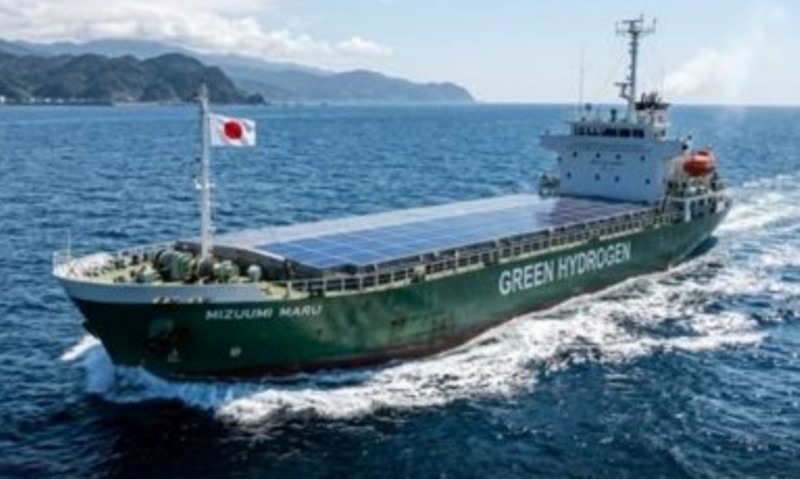
In a development that could reshape the future of sustainable maritime transport, Japan has reportedly launched the world’s first commercial cargo vessel capable of producing its own green hydrogen fuel directly from seawater while at sea. The 8,000-ton autonomous cargo ship, Mizuumi Maru, was developed by Kawasaki Heavy Industries in collaboration with the Japan Shipbuilding Industry Foundation, marking a significant step toward reducing the shipping industry’s carbon footprint.
Maritime transport currently accounts for nearly 3 percent of global carbon dioxide emissions, and the sector has long faced challenges in adopting cleaner fuels due to the vast energy requirements of long-distance ocean voyages. While green hydrogen is widely viewed as a promising alternative, its adoption has been constrained by the need for extensive shore-based production, storage, and bunkering infrastructure.
The Mizuumi Maru seeks to overcome these limitations through an innovative onboard energy system. The vessel is equipped with a 1.2-megawatt solar array covering approximately 2,400 square metres of deck and cargo hatch surfaces. Electricity generated by the solar panels powers a reverse osmosis desalination system and an onboard electrolyser that converts purified seawater into hydrogen.
The hydrogen is stored in magnesium hydride solid-state storage modules, which absorb and release hydrogen through a controlled thermal process. According to the project developers, this storage method eliminates the risks associated with highly compressed hydrogen gas. The stored hydrogen is then fed to fuel-cell systems that generate electricity for propulsion and onboard operations.
The vessel’s energy architecture enables continuous hydrogen production during daylight hours while fuel cells provide round-the-clock power for navigation and cargo operations. This approach allows the ship to operate independently of traditional hydrogen refuelling infrastructure.
According to the project announcement, the Mizuumi Maru completed its first commercial voyage in November 2024, transporting 6,000 tonnes of automotive components from Nagoya to Singapore before returning with electronic cargo. The round trip reportedly lasted 90 days and was completed without any port refuelling stops, while producing zero direct carbon dioxide emissions from propulsion.
Japan’s Ministry of Land, Infrastructure, Transport and Tourism has reportedly certified the vessel’s onboard hydrogen production and storage systems under newly developed regulations for autonomous hydrogen-powered shipping. The technology has also attracted commercial interest, with orders said to have been placed by major Japanese shipping companies Nippon Yusen Kaisha and Mitsui O.S.K. Lines for additional vessels based on the design.
If successfully scaled, the concept could offer a new pathway toward decarbonizing ocean transport by enabling ships to generate fuel from one of the planet’s most abundant resources — seawater — while underway. The project highlights Japan’s continued efforts to position itself at the forefront of next-generation maritime technologies and the global transition to cleaner shipping.