
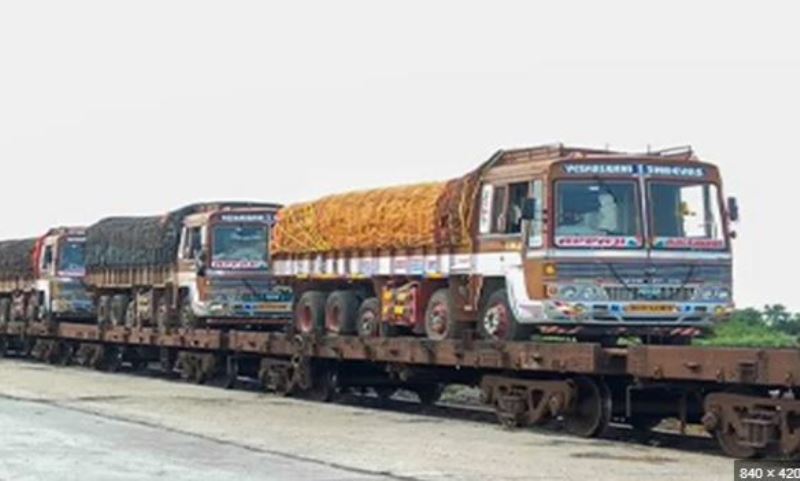
Indian Railways has launched a new Trucks-on-Trains (ToT) service on its Dedicated Freight Corridor (DFC) network, aimed at improving freight efficiency, reducing logistics costs, and easing road congestion.
The service allows loaded trucks to be transported directly on specially designed flat wagons, enabling faster and safer movement of goods over long distances. By integrating road and rail transport, the initiative is expected to lower fuel consumption, cut carbon emissions, and provide shippers with a more reliable and cost-effective alternative to conventional road transport.
Railway officials highlighted that the ToT service will initially operate on key stretches of the DFC network connecting major industrial and logistics hubs. The move is part of Indian Railways’ broader push to modernise freight operations, enhance multimodal logistics, and strengthen India’s supply chain infrastructure.
Industry experts noted that the service could significantly benefit manufacturers, exporters, and transport companies by reducing transit times, minimizing truck wear-and-tear, and expanding capacity without adding road congestion. The program is expected to gradually expand to cover more routes across the country, supporting India’s growing freight demands.