
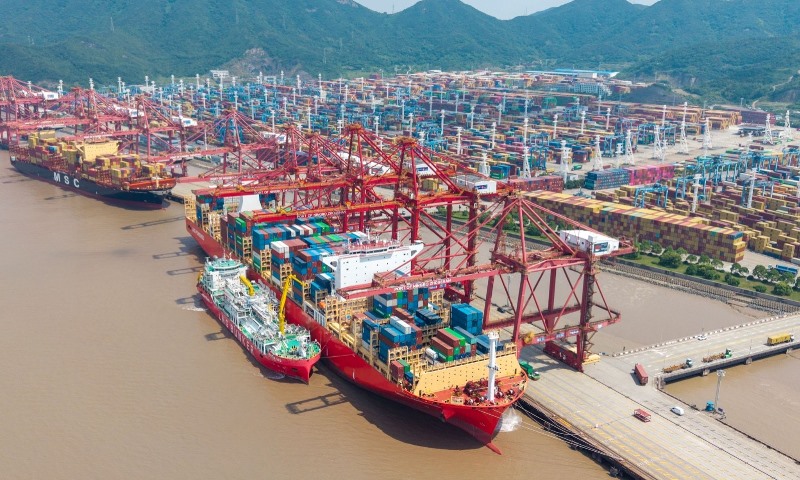
Ningbo-Zhoushan Port has made global port history by becoming the first port in the world to handle more than 1.4 billion tonnes of cargo in a single year, cementing its position as the world’s No.1 port by total cargo throughput for the 17th consecutive year.
According to 2025 performance figures, the port’s container throughput exceeded 43 million TEUs for the first time, enabling it to retain its third-place global ranking in container handling.
Beyond the scale of volumes, the milestone reflects a significant leap in the port’s overall system capability, driven by infrastructure expansion, enhanced deep-water access, stronger intermodal integration, and rapid advances in digitalisation and green shipping services.
Key developments supporting this growth include capacity upgrades across major container and bulk terminals, reinforcing the port’s physical foundation. A major navigational breakthrough was achieved on 26 December 2025, when the Tiaozhumen Channel’s 300,000-tonne expansion completed trial navigation, ushering the core port area into a new “dual-channel” era and improving resilience for ultra-large vessels.
Ningbo-Zhoushan’s global connectivity continued to expand, with 309 container services in operation by end-2025, linking the port to more than 700 ports across over 200 countries and regions.
Intermodal development also reached new highs. The port operated over 110 sea-rail routes, supported by 40 inland dry ports, while sea-rail container volumes surpassed 2 million TEUs during the year—underscoring the growing role of rail in hinterland connectivity.
At the same time, the port made tangible progress in green and smart port development, including new milestones in alternative fuel bunkering and broader deployment of proprietary digital operating systems to enhance efficiency, safety, and emissions management.
In a global environment marked by slower trade growth and rising geopolitical uncertainty, Ningbo-Zhoushan Port’s 2025 performance highlights a clear industry direction: future-ready ports are those that successfully combine scale, connectivity, efficiency, and resilience, while advancing early toward digital transformation and decarbonisation.