
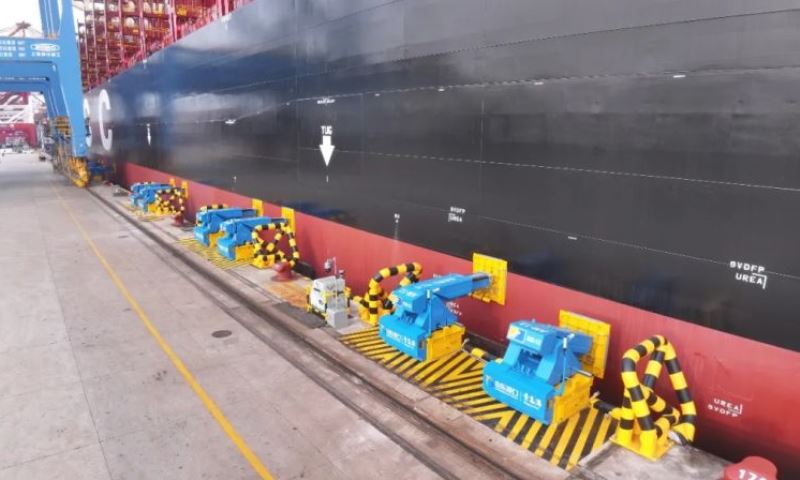
China has reached a major milestone in port automation with the official commissioning of its first vacuum-based automatic mooring system at the Qingdao Automated Container Terminal, operated by Qingdao Port under Shandong Port Group.
The system entered live operation on the first day of the new year when the 366-metre container vessel MSC Saudi Arabia berthed without any crew handling mooring lines on the quay. Instead, the vessel was automatically detected, aligned and secured using high-vacuum suction mooring units, completing the entire mooring process in less than 30 seconds. By comparison, conventional mooring typically requires 20–30 minutes per vessel call.
Advanced technology at the berth
The newly deployed solution features:
13 vacuum mooring units installed along the quay
Up to 2,600 kN of total holding force when units operate simultaneously
Capability to handle container vessels over 200 metres, including today’s largest ships
A three-layer control architecture combining a remote control centre, mobile terminals and local control units
Multi-sensor fusion and intelligent decision-making algorithms, integrating hydraulic drives, high-vacuum suction, real-time vessel motion tracking, and continuous monitoring of wind, wave and current conditions for active station-keeping
Safety, efficiency and sustainability gains
Beyond speed, the most significant benefit lies in operational safety. By eliminating manual line handling, the system removes personnel from high-risk mooring zones and fundamentally reshapes the berthing and unberthing process.
According to Qingdao Port, the technology is expected to save more than 200 hours of berthing time annually per berth, effectively enabling over 10 additional vessel calls each year. The reduced waiting time and smoother operations also contribute to lower emissions and greener port logistics.
A step toward fully intelligent ports
The deployment marks a notable shift in port automation—extending beyond cranes, vehicles and control systems into core berth-side operations. It reinforces Qingdao Port’s position at the forefront of smart port development and highlights how advanced automation is driving end-to-end, high-reliability terminal operations.
With vacuum auto-mooring now operational, China’s port sector has taken another decisive step toward safer, faster and more intelligent maritime logistics.