
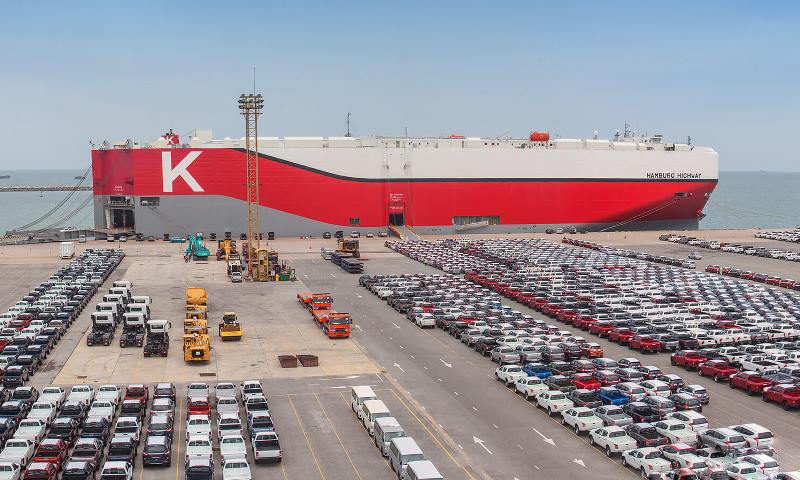
The unit price of South Korea’s exported cars fell last year for the first time in eight years, largely due to a slowdown in electric vehicle (EV) sales. According to the Korea Automobile Manufacturers Association (KAMA), South Korea exported 2.78 million vehicles worth $64.1 billion in 2024, with an average unit price of $23,048. This represents a decrease of $221 from the previous year.
This is the first decline in export prices since 2016, when the average price was $14,264. The unit price had been rising steadily, reaching $23,369 in 2023, fueled by demand for high-priced EVs. However, the recent drop is attributed to reduced global demand for eco-friendly cars, a phenomenon known as the “EV chasm,” which marks a transitional period before widespread EV adoption.
Exports of eco-friendly vehicles, which had been growing from $4.21 billion in 2018 to $23.48 billion in 2023, fell to $22.43 billion last year. Specifically, overseas sales of EVs dropped by 26.6% to 254,000 units.
An industry insider noted that the rise in unit prices in recent years was driven by strong demand for EVs, but the “EV chasm” and production disruptions from heavy snowfall in November 2024 led to the decline in exports.
In response, the South Korean government announced plans to allocate 1.5 trillion won ($1.02 billion) this year to boost domestic EV sales, which have also struggled due to safety concerns and limited access to charging stations. By the end of 2024, the total number of EVs and hydrogen fuel cell cars in South Korea reached 720,000, with EVs making up 680,000.
Domestic EV sales fell 9.7% year-on-year to 147,000 units in 2024, marking the second consecutive annual decline.