
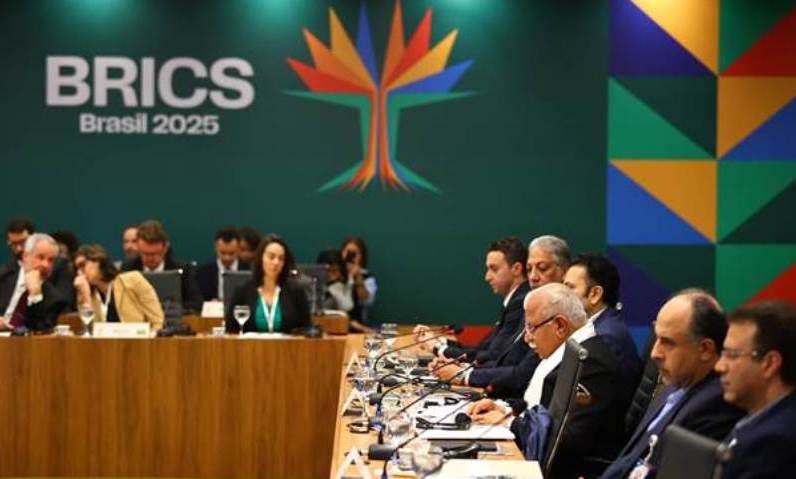
India has called for the dismantling of export controls among BRICS nations to strengthen intra-bloc trade and promote greater solidarity within the Global South, the ministry of commerce & industry said in a statement on Friday. The appeal was made on Wednesday, during the 15th BRICS Trade Ministers’ Meeting under Brazil’s presidency.
A key outcome of the meeting was the endorsement of a joint declaration, along with three annexures: the BRICS Declaration on WTO Reform and Strengthening of the Multilateral Trading System, the BRICS Data Economy Governance Understanding, and the BRICS Trade and Sustainable Development Framework.
“These documents collectively reaffirm BRICS’s commitment to equitable, inclusive, and rules-based global trade,” the ministry said.
The joint declaration also cautioned that climate-related trade measures should not be used as instruments of unjustifiable discrimination or disguised trade restrictions.
‘Resolve longstanding developmental issues’
Held under the theme “strengthening global south cooperation for more inclusive and sustainable governance”, the meeting saw India underline the urgency of resolving longstanding developmental issues, and particularly advocate for a permanent solution to public stockholding (PSH) for food security.
The ministry also highlighted India’s ‘30 for 30’ proposal, which aims to introduce 30 incremental reforms to mark the 30th anniversary of the WTO in 2025.
India reiterated that sustainable development is deeply embedded in its cultural ethos and must remain a cornerstone of global trade governance.
Representing India at the meeting was Yashvir Singh, economic adviser in the department of commerce, who highlighted the need to eliminate restrictive trade measures that disrupt critical supply chains.
He urged developed countries to facilitate the concessional transfer of environmentally sound technologies, backed by adequate financial support.
Singh also highlighted Mission LiFE, India’s global initiative promoting mindful consumption and circular economy practices as part of a fair and inclusive climate responsibility framework.
“Digital transformation and technology-driven growth were recognised as vital areas for future collaboration,” the statement said.
“The BRICS Data Economy Governance Understanding acknowledged DPI as a key enabler of digital economic transformation,” it said.
India’s flagship initiatives
Meanwhile, India reaffirmed its leadership in inclusive digital governance through flagship initiatives such as Digital India and IndiaAI, while reiterating its commitment to global cooperation in digital public infrastructure (DPI), artificial intelligence, and cybersecurity through platforms such as the Global Partnership on AI (GPAI) and the G20, the statement added.
BRICS—which comprises Brazil, Russia, India, China and South Africa—is a powerful alliance of emerging economies that together represent over 40% of the global population and nearly a quarter of global GDP.
Originally focused on economic cooperation, the bloc has grown into a key platform for shaping global governance, advocating for reforms that reflect the interests of the Global South.
The inclusion of new members such as Indonesia also signals its growing relevance as a voice for emerging economies in pushing for a more balanced, and multipolar world order.