
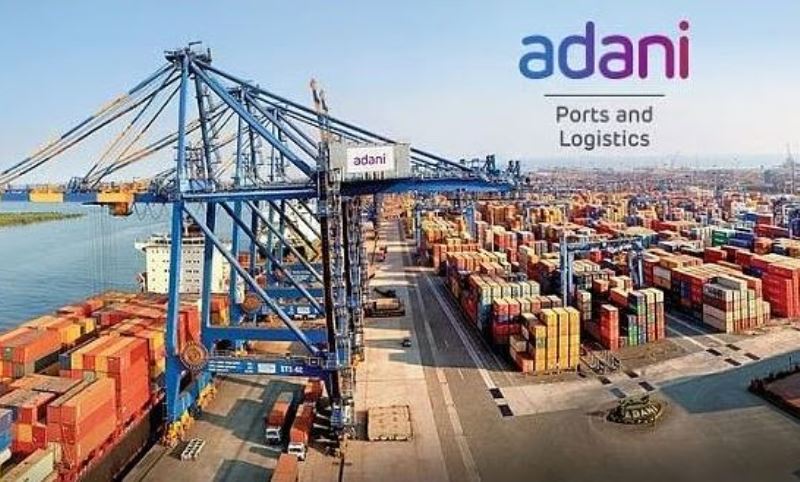
Adani Ports and Special Economic Zone Ltd. (APSEZ), India’s largest integrated transport utility, recorded a 16% year-on-year growth in cargo volumes for August 2025, handling 41.9 million metric tonnes (MMT). The growth was primarily driven by a 29% surge in container traffic, further cementing APSEZ’s leadership in port operations and its role as a critical enabler of India’s trade.
Mundra Port, APSEZ’s flagship gateway on India’s western coast, delivered a string of record-breaking performances during the month. The T2 terminal achieved its highest-ever monthly throughput of 1,29,780 TEUs, while Adani Mundra Container Terminal (AMCT-CT2) set a new benchmark with 1,04,793 TEUs handled across 40 vessels, surpassing its previous best of 1,01,441 TEUs in July 2023.
Mundra’s RoRo operations also set a new single-day record on August 29, wharfing 1,460 cars and overtaking the earlier high of 1,435 cars achieved in March 2025. Container and rail operations similarly saw new peaks, with the port handling 0.97 lakh outward container TEUs across 756 import rakes. Double stack handling also reached fresh highs, with 542 import rakes carrying 0.31 lakh TEUs. Overall double stack volumes touched 0.50 lakh TEUs across 885 rakes, surpassing the previous record of 0.46 lakh TEUs in July 2025.
Across its network of ports, APSEZ handled 202.6 MMT of cargo during the April–August 2025 period, reflecting an 11% year-on-year increase, supported by a 22% rise in container volumes. Logistics operations also continued their upward momentum, with rail volumes reaching 57,347 TEUs in August (up 8% year-on-year) and GPWIS cargo at 1.69 MMT (up 3%). On a year-to-date basis, rail volumes rose 14% to 2,97,766 TEUs, while GPWIS cargo climbed to 9.35 MMT, registering a 3% growth.
Beyond operational records, Mundra Port continues to hold significant economic and strategic value. As India’s largest commercial port and the country’s principal gateway for containerized, bulk, and liquid cargo, it plays a pivotal role in linking hinterland markets with global supply chains. Its seamless multimodal connectivity reduces logistics costs, enhances trade competitiveness, and supports national initiatives such as Make in India and Maritime India Vision 2030.