
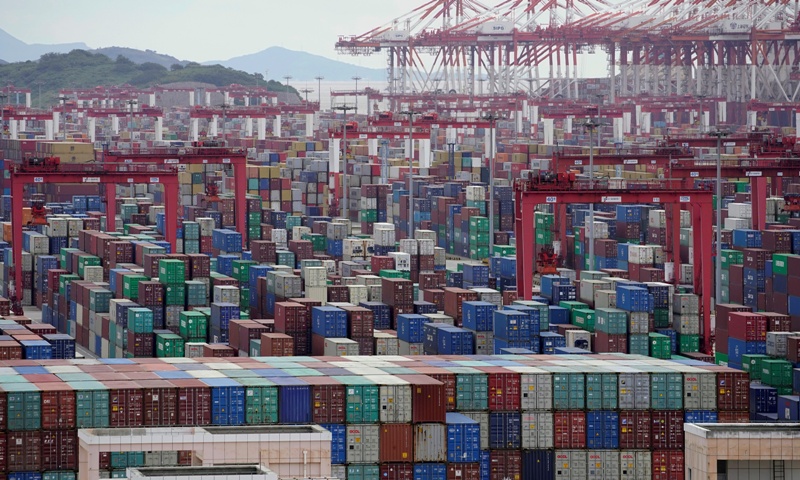
The container ship Istanbul Bridge has departed from Ningbo-Zhoushan Port in eastern China, marking the official launch of the world’s first China-Europe Arctic express container shipping route. Headed for the UK’s Port of Felixstowe—the largest container port in the country—the vessel is expected to complete its journey in just 18 days, setting a new speed record for shipping between Ningbo and Europe.
This groundbreaking route connects major Chinese ports—Ningbo, Shanghai, Qingdao, and Dalian—with key European ports such as Felixstowe, Rotterdam (Netherlands), Hamburg (Germany), and Gdańsk (Poland). By traversing the Arctic Ocean, the route drastically shortens the shipping distance, giving Chinese exporters a strategic edge—especially during Europe’s peak holiday stocking season.
Zhou Xiaoping, Deputy Director of Daxie Customs under Ningbo Customs, stated that the ship is carrying a broad range of goods including daily essentials, clothing, industrial components, as well as high-value products like energy storage cabinets and power batteries. Upon arrival, the cargo will be distributed throughout Europe.
According to data from Ningbo Customs, the European Union remains Ningbo Port’s largest trading partner. From January to August this year, trade between Ningbo Port and the EU totaled 330.74 billion yuan (approximately $46.5 billion), marking a 12% year-on-year increase and accounting for 18% of the port’s total foreign trade.
Fast, Efficient, and Geopolitically Safer
Li Xiaobin, Chief Operating Officer at Sea Legend, emphasized that the Arctic route offers major logistical advantages over traditional paths, including shorter distances, lower costs, and faster delivery times. In addition, the route avoids congested and politically unstable regions, reducing risks associated with piracy, conflict zones, and delays.
“The areas this route traverses are relatively geopolitically stable,” said Li, adding that this boosts shipping safety and reinforces China’s vision for the “Ice Silk Road”—a strategic Arctic corridor connecting China and Europe.
Zhou Chujing, logistics procurement manager at smart energy company Sigenergy, noted that the company is using the new route to ship high-value household energy storage equipment—each container valued around $300,000—to Europe via the Netherlands. “The shorter transit time significantly benefits our supply and marketing chain,” she said.
Strategic and Global Impact
Experts say the new Arctic route goes beyond commercial benefits. It aligns with China’s broader geopolitical goals and enhances global trade resilience. Jian Junbo, director of the Center for China-Europe Relations at Fudan University, explained that shipping via the Arctic avoids potential disruptions from conflicts along overland railway routes and provides an alternative to chokepoints like the Suez Canal.
He added that the Arctic Express route could serve as an international public good, encouraging participation from countries like Japan and South Korea. “The Ice Silk Road invites global cooperation to ensure regional stability and shared growth,” Jian said.
Sun Xuejun, Chairman of Zhejiang Seaport Logistics Group, described the launch as the final step in completing Ningbo-Zhoushan Port’s global ocean shipping network. With access now extended to the Arctic Ocean, the port connects directly to the Pacific, Atlantic, Indian, and Arctic oceans—firmly establishing it as a global maritime hub.
“This route is especially attractive for time-sensitive cargo and cross-border e-commerce,” Sun added. “It offers a stable and secure shipping alternative that helps reduce risks, diversify trade patterns, and improve the overall resilience of global logistics.”