
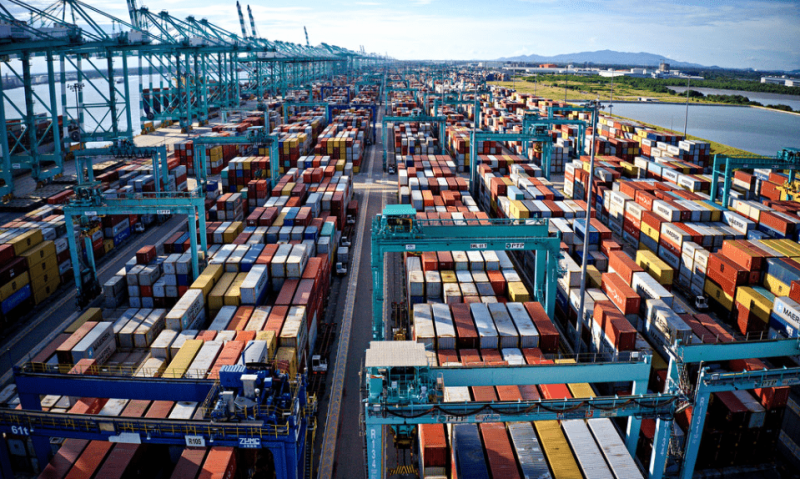
In the first nine months of 2025, the ports of Riga, Liepaja and Ventspils handled a total of 23.9 million tons of cargo, according to data from the port authorities.
Terminals in Riga processed 12.3 million tons, Ventspils 6.5 million tons, and Liepaja 5.1 million tons.
Economics Minister Viktors Valainis said that Latvia’s ports remain the backbone of the national economy, providing stability in the regions and new business opportunities.
“The results of the ports – 23.9 million tons of cargo – confirm that Latvia’s transit and logistics sector can adapt to market changes and become increasingly competitive,” Valainis stated.
In September, Riga terminals handled 1.56 million tons of cargo, a 12% increase compared to August. Agricultural cargo accounted for a third of the total, or 0.52 million tons, the highest monthly figure for this category in the port’s history.
The main product was locally produced wheat. Riga also received 37,000 tons of wheat products shipped from Sweden, using its warehouse capacity for grain consolidation before re-export.
During the first nine months, the volume of cargo in Riga was 6.6% lower than a year earlier. The main categories were containerized cargo (3.65 million tons), agricultural products (2.03 million tons), and forestry cargo (3.88 million tons).
Oil product shipments grew by 38.2%. The port also handled 37,100 tons of liquefied gas in September and 170,000 tons in total during the nine months. Growth was observed in mineral fertilizers (+8.7%) and construction materials (+46.8%) compared to 2024.
Riga also saw a record number of cruise passengers, with 78 ships serving 101,900 passengers, 28,200 more than a year earlier.
According to a study by the think tank CERTUS, each ton of cargo handled at the Port of Riga contributes EUR 10.7 to Latvia’s GDP, equivalent to EUR 131 million over nine months.
Elīna Štrodaha, board member of the Latvian Stevedoring Companies Association, said that port operators are adapting to changing geopolitical conditions by attracting new partners and clients.
She emphasized the role of government support and participation in foreign visits to strengthen the visibility of Latvian businesses abroad.
Terminals at the Port of Ventspils handled 6.5 million tons of cargo, up 15% from the same period in 2024. Growth was recorded in oil products, coal, and Ro-Ro cargo segments.
Almost half of all cargo (2.9 million tons) consisted of liquid cargo, with oil products up 39%. Ro-Ro cargo totaled 1.2 million tons (+22%), and Kazakh coal shipments reached 1.1 million tons (+60.5%). Ventspils also handled various wood, agricultural, and chemical products, while manganese ore transshipment stopped completely due to sanctions.
In the Port of Liepaja, total cargo volume in September was 635,800 tons, up 27.97% from September 2024. Bulk cargo dominated at 459,300 tons, mainly grain (329,600 tons) and construction materials (75,900 tons). Oil products amounted to 22,300 tons. In total, 99 vessels and 8,232 passengers were served in September.
During the first nine months of 2025, Liepaja handled 5.1 million tons of cargo, 2.7% less than a year earlier. Bulk cargo made up 66% of the total (3.36 million tons). Grain reached 2.05 million tons, construction materials 0.6 million tons, and oil products 2.2 million tons. General cargo totaled 1.5 million tons, with 86,615 Ro-Ro units, 871 ships, and 81,798 passengers served.
Riga Freeport Authority is a state and municipal institution managing the Port of Riga, one of the largest seaports in the Baltic region. It oversees port infrastructure, development strategy, and the regulation of port operations.
Port of Ventspils is an independent state authority managing one of Latvia’s main deep-water ports. It specializes in oil products, chemicals, and Ro-Ro cargo, and is part of Latvia’s national transport and logistics network.
Port of Liepaja operates within the Liepaja Special Economic Zone. The port handles diverse cargo, including grain, construction materials, and oil products, and supports industrial and logistics development in western Latvia.
CERTUS Think Tank is an independent Latvian economic research organization focusing on national competitiveness, productivity, and economic development analysis.
Latvian Stevedoring Companies Association is a non-governmental organization representing port stevedoring and logistics companies, promoting cooperation with government institutions and supporting the maritime sector’s competitiveness.