
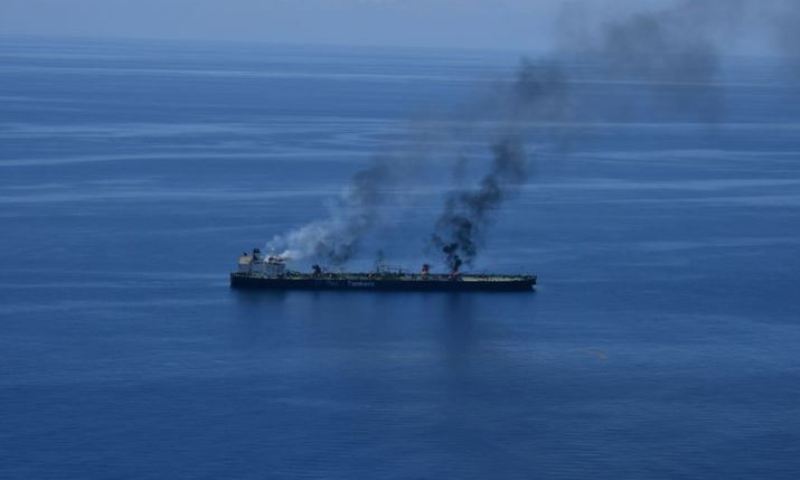
An Indian seafarer was killed and eight crew members were injured after two UAE-flagged oil tankers were struck by Iranian cruise missiles in the Strait of Hormuz early Tuesday, marking a sharp escalation in regional tensions and raising fresh concerns over the safety of commercial shipping in one of the world’s busiest maritime corridors.
According to the UAE Ministry of Defence, the tankers Mombasa and Bahia were targeted by two Iranian cruise missiles while transiting the southern passage of the Strait of Hormuz in Omani territorial waters.
One Indian crew member aboard the Mombasa lost his life in the attack, while eight others sustained injuries. The injured include six Indian nationals and two Ukrainian nationals, with four of them reported to be in serious condition.
The missile strikes also ignited fires aboard both vessels, causing material damage. Emergency response teams successfully brought the fires under control, the ministry said.
Describing the attack as a “serious violation and a clear breach of international law,” the UAE strongly condemned the incident and affirmed its right to take all necessary measures to safeguard its sovereignty and national interests.
“The state reserves its full right to respond to this escalation and to take all necessary measures to protect its territories, people, and residents,” the UAE Ministry of Defence said in an official statement.
Authorities added that the country’s defence and emergency services remain on high alert and urged the public to rely solely on official sources for verified information.
Heightened Tensions in the Strait of Hormuz
The attack comes amid rapidly escalating military tensions in the Strait of Hormuz, through which nearly one-fifth of global oil supplies transit.
Earlier, Iran’s semi-official Tasnim News Agency reported that Iranian forces had targeted several “violating” vessels operating in the Strait. Meanwhile, state broadcaster IRIB claimed the Iranian Navy had launched cruise missiles at what it described as a “hostile vessel of the American enemy,” citing an unnamed military source.
The latest developments follow a fresh round of US military strikes against Iranian targets.
The US Central Command (CENTCOM) confirmed on Monday that it had launched additional operations aimed at reducing Iran’s capability to attack civilian vessels and commercial shipping in the strategically vital waterway.
“These strikes will continue imposing a heavy cost on Iranian forces and degrade their ability to attack innocent civilians and commercial shipping in the Strait of Hormuz,” CENTCOM said.
US Reinstates Maritime Blockade
US President Donald Trump also announced the reinstatement of a maritime blockade targeting Iranian shipping and said the United States would impose a 20% security fee on eligible cargo transiting the Strait of Hormuz to offset the costs of protecting international shipping.
“We’re protecting a very rich portion of the world. We’re spending money. And so, what we’ve done is, we are going to be reimbursed for protection,” Trump said.
The US military stated that the blockade would take effect from Tuesday, applying to vessels travelling to and from Iranian ports while allowing commercial traffic that complies with the restrictions to continue.
The latest attack underscores the growing risks facing merchant shipping in the Gulf region, with the Strait of Hormuz once again emerging as a flashpoint for global maritime security and international trade.