
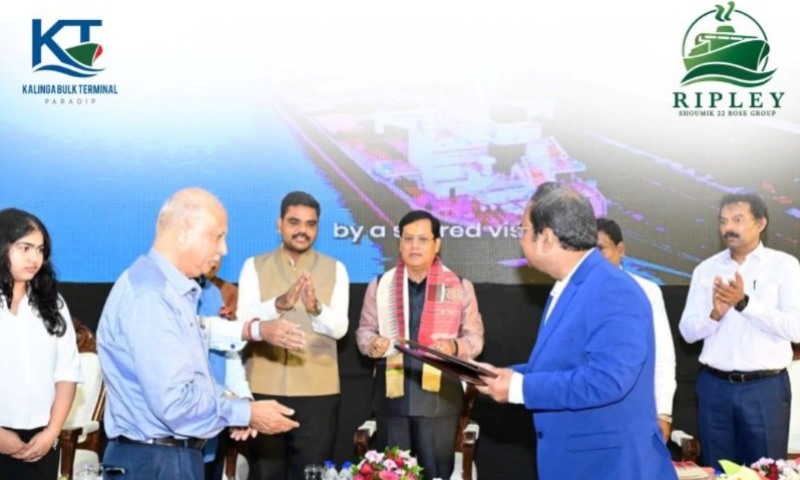
Paradip Port Authority has signed a Concession Agreement with the Ripley & Bothra Group consortium for the mechanisation and development of the Multipurpose Berth (MPB), marking a significant step towards enhancing bulk cargo-handling infrastructure at the port.
The berth, to be developed as Kalinga Bulk Terminal Paradip (KBTPL), will be operated on a 30-year Build-Operate-Transfer (BOT) basis. The project entails an estimated investment of ₹630 crore and is planned to have a cargo-handling capacity of 8 million tonnes per annum (MTPA).
The agreement was signed in the presence of Sarbananda Sonowal, Union Minister for Ports, Shipping & Waterways; P.L. Haranadh, Chairman, Paradip Port Authority; and T. Venu Gopal, Deputy Chairman, Paradip Port Authority.
With the development of KBTPL, the Ripley Group will further strengthen its operations at Paradip Port. Together with KICTPPL, its existing terminal, the group’s facilities at Paradip will have a combined cargo-handling capacity of 20 MTPA.
The project is expected to contribute to the modernisation and mechanisation of cargo-handling operations at Paradip Port while strengthening the port’s ability to handle growing bulk cargo volumes efficiently.
The development reflects the continued focus on creating efficient, modern and future-ready port infrastructure and supporting the expansion of India’s maritime and logistics ecosystem.