
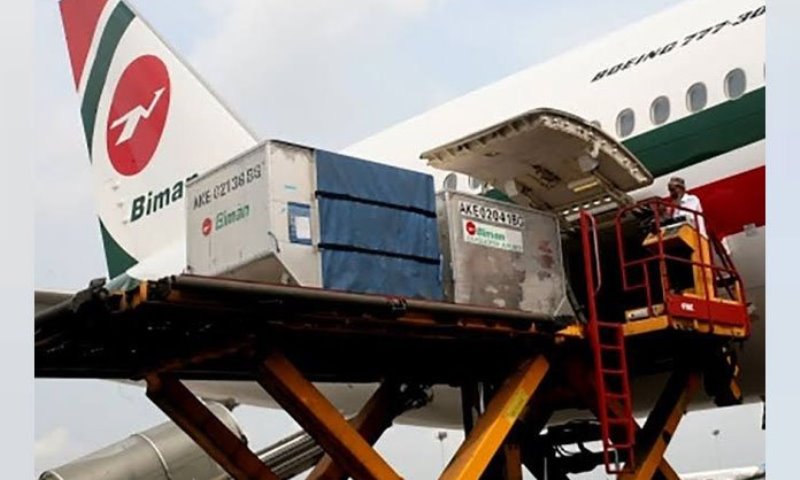
In response to India’s abrupt suspension of a key transhipment route, the Civil Aviation Authority of Bangladesh (CAAB) has recommended major reductions in air cargo charges at the country’s airports to strengthen Bangladesh’s own freight capacity.
A senior CAAB official confirmed to BSS that the proposals, submitted to the ministry on Monday, include lowering landing, parking, and ground-handling fees—particularly for Biman Bangladesh Airlines, which handles all ground operations at Dhaka’s Hazrat Shahjalal International Airport (HSIA).
“As per directives from the highest level, we’ve proposed adjustments to make cargo operations smoother and cheaper. The final decision now rests with the ministry,” said the official, noting that the recommendations were drawn up in coordination with Biman.
The move comes after India unilaterally revoked a four-year agreement that had allowed Bangladeshi goods, mostly garments, to be trucked to Indian airports such as Kolkata and Delhi for onward air shipment. Prior to the halt, about 600 tonnes—roughly 18% of Bangladesh’s weekly air cargo exports—were routed through India, according to the Bangladesh Freight Forwarders Association (BAFFA).
Commerce and Civil Aviation and Tourism Adviser Sk Bashir Uddin said the government is committed to making Bangladesh’s cargo services more competitive than Indian transhipment routes. “We are determined to reduce cargo costs and make our services even more competitive,” he told BSS.
CAAB Chairman Air Vice Marshal Md Monjur Kabir Bhuiyan echoed that resolve, stating, “We have been instructed at the highest level to keep air cargo operations running smoothly regardless of external factors, and we hope to announce reduced charges very soon.”
As part of broader expansion efforts, CAAB has deployed additional manpower at HSIA’s cargo terminal and launched full-scale cargo operations at Sylhet’s Osmani International Airport on April 27. Airports in Chattogram and Cox’s Bazar are expected to follow soon. Efforts are also underway to accelerate customs clearance.
The upcoming full operation of HSIA’s third terminal—expected later this year—will significantly boost national cargo handling capacity from 200,000 to 546,000 tonnes annually. The terminal includes a 36,000-square-metre cargo zone with automated systems and larger storage areas.
“These improvements will allow us to handle cargo more independently and efficiently, substantially increasing both operational efficiency and revenue,” Bhuiyan said.
Currently, Biman’s passenger aircraft carry about 16–17% of HSIA’s annual cargo load of roughly 175,000 tonnes. Biman also provides ground-handling services for major international cargo carriers like Emirates, Qatar Airways, Turkish Airlines, and others.
Despite this capacity, exporters have long complained about high logistics costs and bottlenecks at HSIA. The airport’s current infrastructure—originally built to handle 300 tonnes per day—now frequently processes over 1,200 tonnes in peak periods.
HSIA’s handling charge of around $0.29 per kilogram is nearly six times higher than Delhi’s $0.05 per kilogram. Jet fuel costs in Dhaka are also 30% more expensive than in India, although a recent reduction in local fuel prices has offered some relief to exporters.
Still, industry leaders view the disruption as an opportunity. Aviation stakeholders believe that Bangladesh now has a chance to reposition itself as a self-reliant and competitive regional air cargo hub.