
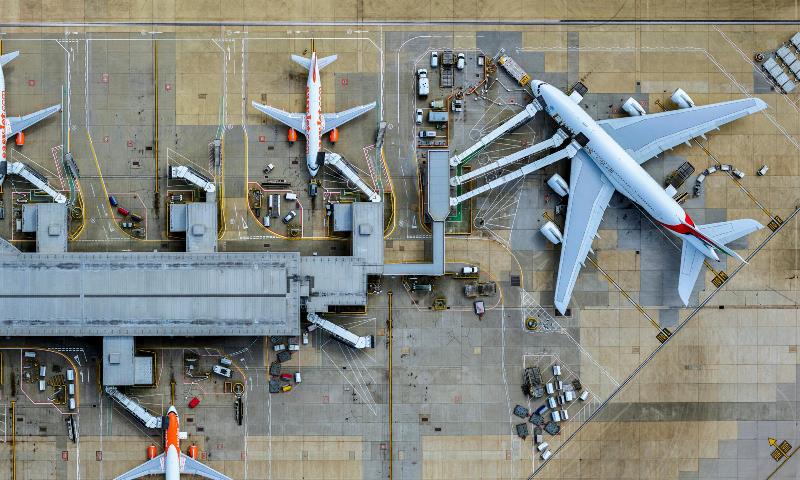
Forwarders and airlines fear new bottlenecks at airports as cargo growth outpaces infrastructure investment.
Brandon Fried, executive director of the Air Forwarders’ Association, said on the sidelines of IATA’s CNS conference in Miami last week: “I think you’re going to see a bullwhip effect, because there’s an uptick in the demand for air freight, at least in the short term.
“We’re going to see bottlenecking again. We’re already seeing it now, where trucks are waiting two, three hours.”
He added that during the pandemic, some trucks were “waiting nine hours,” and urged that major airports “need investment in infrastructure”.
Mr Fried explained: “When you look at the forecast for air cargo, to be increasing 3%-4% every year for the next 20 years, these airports are not going to be able to handle those volumes.
“It’s not just here in the United States, it’s elsewhere too, and this is a big concern. But here in the US, they need federal investment, and until they get that, they’re not going to be able to revamp their cargo areas.”
Indeed, Peter Cerda, IATA regional VP Americas, said: “On the airport side, MIA is the fifth most used cargo facility in the world, but it’s a saturated airport with very little room for growth and investment in the area. When there is growth, it’s always on the passenger side.
“While you’re moving significant amounts of cargo, you’re the secondary citizens of the airport ecosystem. If our airports are already saturated, what’s the plan?” he asked.
Andrés Bianchi, CEO of LATAM Cargo, said: “Some airports have already figured out how to use space vertically, and the addition of technology allows you to do that. The critical question becomes how visionary the airport is, and how streamlined procedures are.”
“Airports probably used to think that cargo was never going to move away from them. But airports matter, and customers will shift their demand from the lower performing airports to those better-performing.
“That’s when the airports will realise ‘this can actually make an impact, and we better provide better service’,” he added. “Some airports are impossible, others are amazing. They allow you to do business faster. Eventually, we’re going to move toward the airports that are more flexible, that give us more support. “
Basil Khalil, VP of operations central America and the Caribbean at FedEx Express, said the integrator had been investing in ground infrastructure in North America, Europe and South America and hoped that the extra investment, paired with additional capacity, “may open opportunities to allow certain customers to be able to continue to grow and find more cost-effective players”.
Stephanie Abeler, VP Americas for Lufthansa Cargo, said the airline was investing €600m in Frankfurt “to be more state of the art, to increase the facilities, to be compliant with sustainability, to be more automated, to be able to handle more freight”.
“But Frankfurt is our hub, so there we have different influences,” Ms Abeler added. “When I go to an airport in, say, the US, I’m a pretty small player in some areas, so when we come in with a flight three times a week, I want to put cargo on that flight – but if there is no warehouse, it’s going to be tough.”
Peter Penseel, president of Delta Air Lines Cargo, commented: “I think it’s up to us. We have to be vocal on bringing cargo to attention. When I joined Delta, I wanted to make it really clear that cargo can be a differentiator.
“That’s also true for the airport… because if you see the size of the business and the revenue attached, you know how the discussions are in the boardroom when it comes to passenger versus cargo, but also the income generated as an airport.
“Nevertheless, I think we have to be clear that cargo can and will be able to make the business case.”
Mr Fried noted a mandate sponsored by the Air Forwarders Assocation “calling for a government accountability office study on airport cargo congestion” was under way and should be completed by summer.