
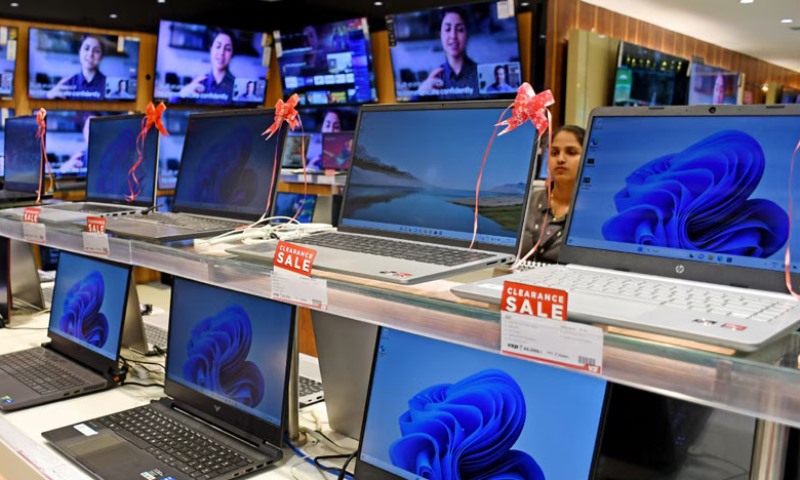
The government’s policy flip-flops on restricting imports of laptops and similar products have increased business uncertainty and costs, think tank GTRI said on Wednesday.
A decisive and consistent policy is crucial to encourage global technology companies to shift manufacturing units to India and build a robust electronics supply chain, it added.
To promote local manufacturing and reduce reliance on China, the government must announce a stable and long-term policy, it noted.
India, it said, is bound by the ITA-1 (information technology) agreement of the World Trade Organisation (WTO) and cannot raise import duties, leaving import restrictions as the primary tool for fostering domestic production.
However, the repeated extensions of import authorisations and delays in implementing a clear Import Management System (IMS) have undermined these efforts, the think tank said.
“A decisive, consistent policy is crucial to encourage global tech companies to shift manufacturing to India and build a robust electronics supply chain,” GTRI founder Ajay Srivastava said.
India has kept import duties on computers, laptops, and similar products at zero due to its commitments under the Information Technology Agreement (ITA-1), which obligates participating countries to maintain zero tariffs on certain technology products.
“This agreement limits India’s ability to impose higher duties on imports to discourage foreign competition. With import duties off the table, India’s remaining option was to restrict imports to foster local manufacturing,” he added.
On August 3, 2023, the government first imposed import restrictions on laptops, tablets, all-in-one personal computers, ultra-small form factor computers, and servers.
After the industry flagged concerns over the curbs, the government in October last year rolled out an import management/ authorisation for imports of these products.
The system is aimed at monitoring inbound shipments of these items into the country without hurting market supply.
The government on Tuesday extended the existing approval system for import of certain IT hardware products, including laptops and tablets, for three months till December 31.
Importers would have to apply for fresh authorisations from January 1, 2025.
Srivastava said that given that China controls 81 per cent of the global PC and laptop market, India is right to reduce its dependence on a single country for its electronics supply chain.
By restricting imports and encouraging phased domestic manufacturing, India can swiftly indigenise its electronics industry.
India’s import of desktops, laptops and related products in 2018-19 was $6.4 billion and $6.5 billion in 2019-20. It increased to $8.2 billion in 2020-21 and $11.3 billion in 2021-22.
The imports slightly declined to $10.1 billion in 2022-23 and $9.4 billion in 2023-24.
China accounted for 54.7 per cent of India’s imports last fiscal. It was followed by Singapore (15.1 per cent) and Hongkong (8.3 per cent).
GTRI said India’s hesitancy to implement strict laptop import restrictions, possibly influenced by concerns from the US, needs to be resolved decisively.
“Such restrictions would compel global tech giants like Apple, Dell, and HP, which currently manufacture in China, to consider shifting production to India,” it added.